 English
 French
 German
 Russian
 中文
中文

White Teeth by Zadie Smith: A Hilarious, Chaotic Story About Identity in Modern Britain
A Very Strange Way to Start a New Life
There are many ways to start over in life. Some people move to a new country. Others take up meditation or join a gym. Archie Jones, however, chooses a rather unusual method: he tries to gas himself inside a halal butcher’s van.
His plan fails—not because of a sudden realization about the value of life, but because the butcher politely asks him not to commit suicide on his property.
That absurd moment is how White Teeth begins, and it perfectly sets the tone for the entire novel: chaotic, funny, deeply human, and full of unexpected turns.
Published in 2000, White Teeth launched Zadie Smith onto the literary scene with incredible force. She was only 24 years old when the novel came out, yet she managed to write a sprawling, ambitious story about immigration, identity, religion, science, and the complicated lives of families in multicultural London.
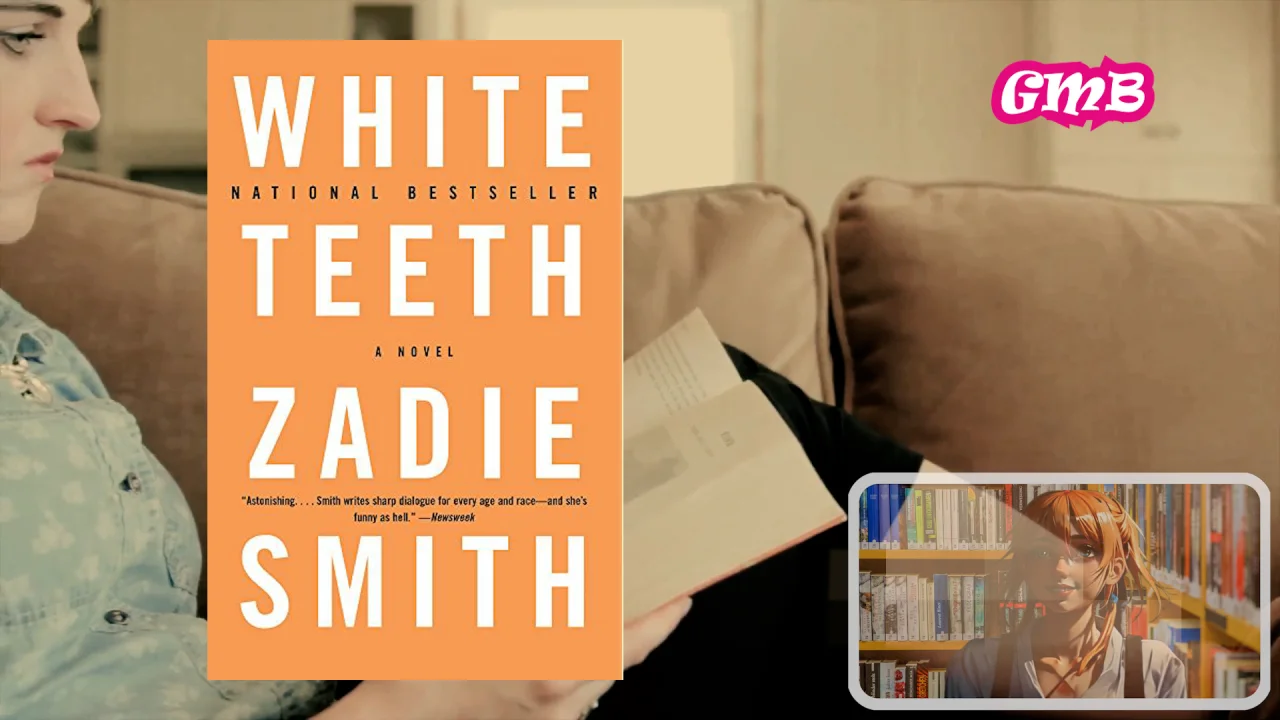
If you’re curious about reading the same edition, you can check it out here:
👉 https://amzn.to/48MQGIk
Summary: A Story of Families, Culture, and the Chaos of Identity
At its core, White Teeth follows two interconnected families living in London.
The first is Archie Jones, an ordinary British man whose life seems defined by indecision and accidental outcomes. After his failed suicide attempt, Archie marries Clara Bowden, a young Jamaican woman who is rebelling against her deeply religious Jehovah’s Witness mother, Hortense.
The second family centers on Samad Miah Iqbal, Archie’s old friend from World War II. Samad is a Bangladeshi immigrant struggling to maintain his cultural and religious values while living in a society that constantly pulls his family in different directions. His wife, Alsana, works tirelessly to support their household while raising their twin sons, Millat and Magid.
Both families soon have children of their own.
Clara and Archie have a daughter named Irie Jones. Samad and Alsana have the twins, Millat and Magid.
From that point onward, the novel explores what it means to grow up between cultures.
Samad becomes terrified that his sons will lose their cultural identity in Western society. In a desperate attempt to preserve tradition, he secretly sends Magid back to Bangladesh to be raised in what he believes will be a more “authentic” environment.
But the plan backfires.
Magid returns years later as the most Westernized character in the entire novel—rational, scientific, and eager to help a geneticist with a controversial experiment involving a genetically engineered mouse called FutureMouse.
Meanwhile, the twin who stayed behind, Millat, drifts into rebellion and eventually joins a radical Islamist group.
At the same time, Irie struggles with her own identity, beauty standards, and cultural belonging. Her journey—especially her painful attempts to alter her hair to fit societal expectations—becomes one of the most emotionally resonant threads in the book.
All these characters eventually collide during the unveiling of the FutureMouse experiment, where religious activists, radical groups, animal rights protesters, and confused family members all converge in a chaotic showdown.
Analysis & Review: Why White Teeth Works So Well
A Brilliant Exploration of Identity
One of the novel’s greatest strengths is how honestly it explores identity in a multicultural world.
Nearly every character in White Teeth feels pulled in two directions.
Samad wants to preserve tradition but lives in a society that constantly challenges it. Millat wants to belong but feels rejected by the culture he grew up in. Irie struggles with beauty standards and the pressure to fit into an identity that doesn’t feel natural.
Rather than offering simple answers, Zadie Smith shows how messy identity really is.
The characters constantly fail, change, and contradict themselves. And that’s exactly what makes them feel real.
Humor That Never Undermines the Serious Themes
Despite tackling heavy topics like immigration, religion, racism, and globalization, the novel is often laugh-out-loud funny.
Archie, for instance, is almost comically average. He drifts through life making decisions based on coin flips and convenience.
Samad, meanwhile, takes himself extremely seriously—even while working humiliating restaurant jobs and failing to control his own family.
Smith’s humor isn’t cruel. Instead, it highlights the absurdities of life and the contradictions people carry within themselves.
A Sharp Satire of Ideology
Another strength of the novel is how it critiques different belief systems.
Throughout the book, we see:
-
Religious fundamentalists
-
Radical political groups
-
Scientific idealists
-
Cultural purists
Each group believes they possess the truth.
Yet Zadie Smith reveals how every ideology—religious or scientific—can become rigid, self-righteous, and blind to reality.
The FutureMouse experiment becomes the perfect symbol for this conflict. It represents the idea of predetermined destiny, raising questions about free will, fate, science, and morality.
By the time all the competing factions clash at the experiment’s unveiling, the scene becomes both hilarious and deeply symbolic.
Irie’s Story: One of the Most Powerful Threads
Among the many characters, Irie Jones arguably has the most emotionally resonant journey.
Her struggle with her hair—trying chemical straightening, then switching to expensive hair extensions—becomes a powerful metaphor for identity and self-acceptance.
Smith highlights a painful truth: many people feel pressured to change their appearance in order to fit social expectations.
The irony is striking.
Poor immigrants spend huge amounts of money altering their appearance, while others sell their hair for survival.
It’s a subtle but devastating commentary on beauty standards and cultural pressure.
The Novel’s Biggest Weakness
If there is one weakness in White Teeth, it’s the sheer number of characters and subplots.
The novel is long—over 500 pages—and packed with stories, perspectives, and historical references.
Some readers might find the narrative a little overwhelming at times. Certain sections move slowly, especially when the story dives deeply into side characters.
However, this complexity is also part of the book’s charm. The sprawling structure mirrors the chaotic, interconnected world the novel is trying to portray.
About the Author: Zadie Smith
Zadie Smith was born in North-West London to a Jamaican mother and an English father, giving her firsthand insight into multicultural Britain.
When White Teeth was published in 2000, it became an instant literary sensation. Critics compared Smith to major literary figures, praising her ability to blend humor, cultural insight, and ambitious storytelling.
Since then, she has written several acclaimed novels, including:
-
On Beauty
-
NW
-
Swing Time
But White Teeth remains her breakthrough work and one of the most celebrated novels about modern British identity.
If you'd like to read the novel, here’s a popular paperback edition:
👉 https://amzn.to/48MQGIk
Conclusion & Recommendation: Who Should Read White Teeth?
White Teeth is not a simple novel.
It’s sprawling, chaotic, and filled with clashing voices and ideas.
But that complexity is exactly what makes it so powerful.
This is a book for readers who enjoy stories about:
-
immigration and cultural identity
-
family dynamics across generations
-
the clash between religion and science
-
humor mixed with serious social commentary
If you enjoy ambitious novels that explore big ideas through unforgettable characters, this book is absolutely worth your time.
You can explore the book here:
👉 https://amzn.to/48MQGIk
Final Thoughts
What makes White Teeth remarkable is its honesty.
The novel doesn’t pretend that identity is simple. It doesn’t suggest that tradition or modernity holds all the answers.
Instead, it shows life as messy, contradictory, and constantly evolving.
Families misunderstand each other. Cultures collide. Ideologies clash.
And somewhere in that chaos, people try to figure out who they are.
More than twenty years after its publication, White Teeth still feels incredibly relevant. In a world that continues to wrestle with questions of identity, belonging, and cultural change, Zadie Smith’s novel reminds us that the answers are rarely neat—and that sometimes the truth lives in the mess.