 English
 French
 German
 Russian
 中文
中文

When a President Buys His Wife a London Villa with Tea Exports
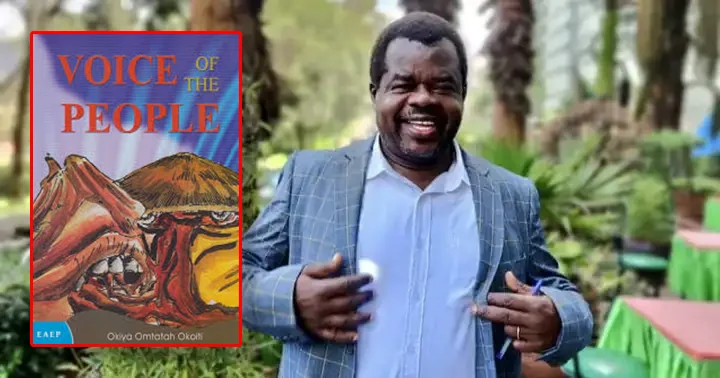
There’s a special kind of laughter that dies halfway through your throat.
That’s the laughter Voice of the People provokes. You smile at first—because the situation is absurd, almost cartoonish. A president, drowning in national crises, obsessing over buying his wife a luxury villa in London. Paid for with tea exports. As a birthday gift.
And then the smile fades.
Because the joke feels uncomfortably familiar.
Okiya Omtatah’s Voice of the People isn’t satire designed for easy amusement. It’s satire that lures you in with humor, then pins you down and forces you to look at the rot beneath power. By the time you’re done, the laughter has turned into something heavier—anger, recognition, responsibility.
👉 You can find the edition I read here: Voice of the People by Okiya Omtatah
A Nation Run Like a Personal Wallet
The play opens without ceremony. No slow buildup. No gentle introductions.
The Head of State—known simply as Boss—is already on the phone, arranging a corrupt deal. He isn’t whispering. He isn’t hiding. He’s bragging. A London villa, fully funded by the people’s tea exports, wrapped up neatly as a birthday gift for the First Lady.
With that single phone call, Omtatah establishes the rules of this world:
corruption is casual, dictatorship is normalized, and public resources exist solely for private pleasure.
Boss isn’t portrayed as a complicated villain with tragic motivations. He doesn’t need to be. His confidence is the point. This is a man so accustomed to power that looting an entire country feels like romance.
When Women Refuse to Be Polite
Resistance arrives not through parliament or political parties, but through Nasirumbi, a forty-year-old schoolteacher and activist. She leads Mothers’ Front, a grassroots movement of women opposing Boss’s grand development scheme—Resort Paradiso Africana.
The project promises progress, investment, and global prestige. In reality, it means cutting down Simbi Forest and enriching a small political elite.
The women refuse.
And not politely.
They threaten to stage a nude protest, a culturally powerful act rooted in African traditions where nudity becomes a weapon of moral shame against unjust authority. It’s shocking, yes—but deliberately so. Omtatah understands that respectable protest is easy for power to ignore. Shame is harder to dismiss.
Predictably, Boss’s government labels them foreign agents. CIA. MI6. Shadowy NGOs. Because in dictatorships, disagreement is never organic—it must be imported.
Nasirumbi is more than a fictional character. She is a clear tribute to Wangari Maathai, the Kenyan environmentalist and Nobel laureate who stood unflinchingly against ecological destruction and political bullying. Through her, Omtatah reminds us that resistance often wears the face of ordinary women who refuse silence.
👉 Available here: Voice of the People – African Plays Collection
Power, Violence, and the Politics of the Body
One of the most disturbing moments in the play comes when Boss attempts to rape Nasirumbi.
The scene is brutal—not because it’s gratuitous, but because it is symbolic. Power asserts itself through domination. Sex becomes a weapon. Consent is irrelevant. Boss sneers, “I love tough women. They bring the best out of me.”
Nasirumbi resists with everything she has.
This moment reframes the struggle entirely. It is no longer just political—it is bodily, intimate, and deeply violent. Yet Nasirumbi’s resistance transforms the scene into an allegory: the powerless refusing to surrender dignity, even when physically overmatched.
Importantly, she does not seek salvation through political office afterward. She rejects the idea of becoming another politician in a broken system. For her, liberation cannot be delivered by messiahs. It must come from ordinary people acting collectively.
That refusal is one of the play’s most radical ideas.
Journalism Under the Boot
The fight against Boss isn’t limited to the streets. In the newsroom, we meet Indondo, editor of The Voice of the People, an independent newspaper that refuses to kneel.
When Indondo publishes a sensitive dossier exposing the Simbi project, Boss panics. His enforcer, Sibuor, moves in with threats and blackmail—waving nude photographs of Indondo with his secretary in a hotel room.
It’s a familiar authoritarian tactic: when truth can’t be silenced, shame is weaponized.
But Indondo refuses to fold. His integrity outweighs his fear.
Meanwhile, Boss bends the judiciary to his will. Courts no longer judge—they obey. When Nasirumbi takes her case to the High Court, it’s dismissed without fairness, without dignity, without justice. The law becomes theater, and Boss holds the script.
The Golden Shield That Exposes Everything
The climax takes place in a national stadium, where Boss is set to receive the Golden Shield of Honour from a World Bank envoy—his ultimate fantasy. International validation. A shiny badge to overwrite domestic suffering.
But the ceremony collapses into nightmare.
Through deception, Indondo becomes Master of Ceremony. The lights go out. When they return, Boss is kneeling—not before glory, but clutching the corpse of a child. Nasirumbi, disguised as the envoy, stands beside him.
The child died in a national hospital because there was no medicine.
The symbolism is devastating. While Boss chased villas and honors abroad, children died quietly at home. The award becomes a corpse. Recognition becomes accusation.
“You killed this child,” Nasirumbi declares.
“And many others.”
There is no escape from that image.
👉 Get your copy here: Voice of the People by Okiya Omtatah
What This Play Is Really Saying
Voice of the People is not subtle—and it doesn’t want to be.
Boss is not a single dictator. He is a template. A composite of leaders obsessed with foreign approval, terrified of dissent, and willing to hollow out institutions to stay in power.
What makes the play endure is its refusal to offer comforting illusions. There is no benevolent savior. No clean revolution. No miracle election. Responsibility shifts uncomfortably toward the audience itself.
Nasirumbi’s final address doesn’t just condemn Boss—it interrogates us. Why do dictators survive? Because people allow them to. Because silence is easier than resistance. Because waiting feels safer than acting.
The use of women as the moral and political vanguard is deliberate and powerful. Omtatah doesn’t portray women merely as victims of corruption, but as its most dangerous opponents. Their protest strategies, rooted in culture and shame, expose how fragile authoritarian masculinity truly is.
And the final image—the dead child—ensures the message cannot be dismissed as “just satire.” Corruption kills. Literally.
About Okiya Omtatah
Okiya Omtatah Okoiti (born 1964) is not only a playwright but one of Kenya’s most relentless human rights activists. Known for dragging governments and corporations to court, his activism is fearless, persistent, and deeply rooted in public accountability.
Voice of the People, published in 2007, reflects that same spirit. It reads less like detached fiction and more like a warning shouted from the frontlines. His writing carries the moral urgency of someone who understands that power only retreats when forced.
Final Thoughts
Voice of the People is uncomfortable—and that is its greatest strength.
It laughs at tyranny only long enough to expose its bloodstains. It rejects the fantasy of heroic politicians and insists on collective responsibility. And it places women at the center of resistance, not as symbols, but as active agents of change.
This is not a play you read and forget. It lingers. It accuses. It asks what role you play in sustaining decay.
Satire, in Omtatah’s hands, is not entertainment.
It is confrontation.
👉 If you want to read the same edition I did, you’ll find it here: Voice of the People by Okiya Omtatah