 English
 French
 German
 Russian
 中文
中文

A City Calling Its Own Name
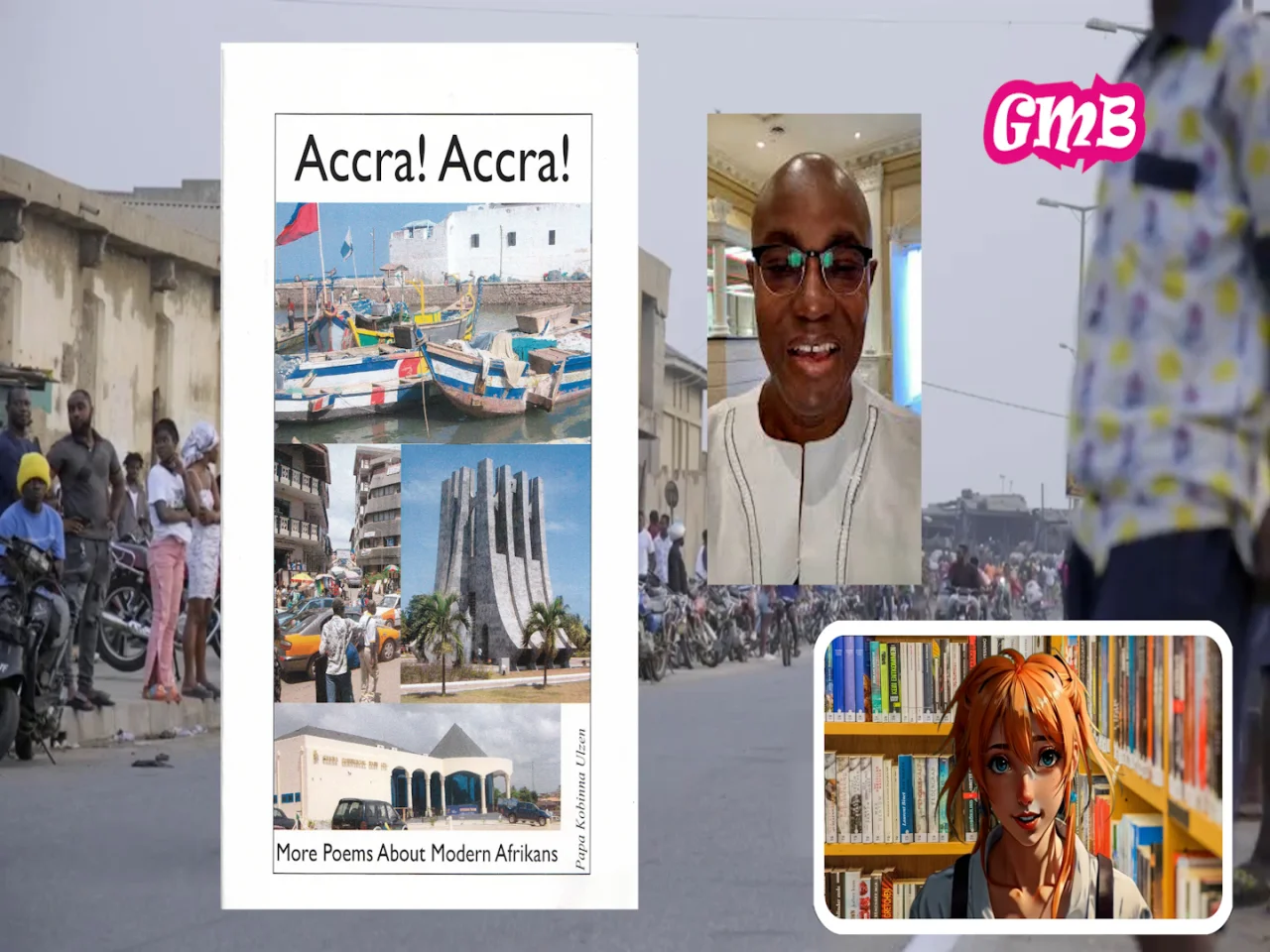
There’s something almost haunting about hearing a city call itself.
“Accra! Accra!”
Not from a map. Not from a tourist brochure. But from the mouth of a trotro mate, half-hanging out of a moving bus, voice cracking under the weight of the day.
When I finished reading Accra! Accra! More Poems About Modern Afrikans by Papa Kobina Ulzen, I didn’t feel like I had just read a poetry chapbook. I felt like I had walked through a street I know too well — dusty, loud, impatient, but alive.
It’s only 28 pages long. And yet, it lingers.
It lingers like a conversation you weren’t ready to end.
What Kind of Book Is This?
This is a reflective, grounded poetry chapbook about modern African identity — not in theory, but in lived reality.
Tone: quiet, observant, sincere
Pace: slow and deliberate
Themes: memory, post-independence disillusionment, urban struggle, colonial legacy, responsibility, hope
This book is for readers who:
-
Love accessible poetry that feels conversational rather than cryptic
-
Think deeply about Africa’s past and present
-
Appreciate writing rooted in real places and real people
This book is NOT for readers who:
-
Prefer dense, abstract, highly symbolic poetry
-
Want dramatic stylistic experimentation
-
Need long narratives instead of reflective snapshots
Why This Collection Matters
What struck me most is how unpretentious this book is.
There are no complicated metaphors. No effort to “sound poetic.” Ulzen is not trying to impress you with vocabulary. He’s trying to speak to you.
And that choice is powerful.
In the opening poem, “Kyekyewere,” he recalls helping to build a classroom block in a small village outside Accra. It’s not framed as heroism. It’s framed as participation. Community. Contribution. Development in its simplest, most honest form.
Then comes “Accra! Accra!” — the poem that gives the collection its name. If you’ve ever used public transport in Ghana, you already know the rhythm:
“Accra! Accra!”
“Sorry, full up.”
“Circle only, sah!”
Those exchanges are more than dialogue. They’re choreography. A system of glances, gestures, nods — a kind of urban telepathy. Ulzen captures this with startling precision.
But beneath the surface, he’s asking something bigger:
What does movement mean in African cities?
Who gets to move freely?
Who gets left behind?
The buses are not just buses. They’re metaphors for aspiration, congestion, and survival.
And then he goes further.
In “What was, What is?” he draws a painful comparison between apartheid-era South Africa and post-independence Kenya. Black bodies herded into mines “like a herd of cattle.” Laborers from Kibera streaming into Nairobi’s industrial area, hoping to be chosen for the day.
And the line that refuses to leave me:
“Though the song has changed, the puppet remains the same.”
That question — have we really changed? — echoes the concerns raised in The Beautyful Ones Are Not Yet Born by Ayi Kwei Armah, or Matigari by Ngũgĩ wa Thiong'o.
Independence came. The flags changed. The anthems changed.
But have we?
In “Any Better?” Ulzen doesn’t wait for an answer. He confronts us directly:
Are we any better than those who enslaved and colonized?
He argues that while colonialism may have retreated geographically, exploitation hasn’t disappeared — it has internalized. Tribe against tribe. Urban against rural. Elite swallowing the sweat of farmers.
And that’s uncomfortable.
Because it means the blame cannot remain external forever.
A Glimpse of the Story (No Spoilers)
There’s no single storyline here.
Instead, there are moments:
-
A young man volunteering in a village
-
A city alive with transport calls
-
Laborers hoping to be chosen
-
A son speaking to the father he never fully understood
-
A prayer for a safer future for the Black child
The conflict isn’t between characters.
It’s between memory and progress.
Between independence and reality.
Between blame and responsibility.
Reminiscence and Hope
Two emotional currents run through this collection: remembrance and hope.
In “Conversations We Never Had,” Ulzen addresses his father with tenderness and unresolved curiosity. It’s vulnerable. There’s no anger — just questions. It’s the kind of poem that feels like reading someone’s private journal.
Then comes “Prayer for the Black Child.” Here, the voice shifts outward. It becomes collective. It becomes visionary.
He hopes for:
“a better place, a safer place for the black child.”
It’s both prayer and protest.
And in “Reclamation,” he makes a decisive turn: stop blaming the colonialists. Take responsibility. Build. Create. Reclaim.
That’s what gives this book weight.
It doesn’t end in bitterness.
It ends in possibility.
About the Author
Papa Kobina Ulzen is Ghanaian-born and has lived in Ghana, Kenya, Zambia, and traveled widely across Africa before settling in Toronto, Canada over two decades ago.
His poetry has appeared in Akwantu: Thoughts of a New Canadian, and he has written and produced short plays such as Karibuni Canada, Malaika, Bus Stop, and Lunch Time Again. He has also worked on a feature-length African-themed play titled Ekua na Kamau, a love story set in Accra.
You can feel that cross-border experience in his writing. He doesn’t speak as a local confined to one geography. He writes as an African who has seen multiple versions of the continent — rural and urban, hopeful and disillusioned.
That perspective gives this slim chapbook surprising depth.
Who This Book Is Perfect For
You’ll enjoy this collection if:
-
You like poetry rooted in everyday African life
-
You appreciate political reflection without heavy theory
-
You read to think — not just to escape
You might struggle with this book if:
-
You prefer fast-moving narrative plots
-
You need highly stylized, metaphor-heavy poetry
-
You expect dramatic poetic experimentation
My Honest Verdict
This isn’t a perfect collection.
Because it’s short, some poems feel like glimpses rather than fully developed meditations. You might wish for more pages. More expansion. More time inside certain themes.
But maybe that brevity is the point.
The simplicity works in its favor. The language is clear. The accessibility makes it powerful. You don’t need a literary degree to feel its impact.
And in a world where poetry can sometimes feel deliberately obscure, that honesty is refreshing.
This is not poetry trying to be clever.
It’s poetry trying to be truthful.
And those are not always the same thing.
Final Thoughts
When I think back to the opening chant — “Accra! Accra!” — I realize the title is more than a transport call.
It’s a summons.
A call to look at ourselves.
A call to examine what independence has truly delivered.
A call to remember — and to rebuild.
If you care about African literature that reflects lived realities rather than romanticized narratives, this chapbook deserves your attention.
It may be just 28 pages.
But it asks questions that are much longer than that.
Until then — keep reading. Keep reflecting. And stay grounded.