 English
 French
 German
 Russian
 中文
中文

Kwame Nkrumah: Vision and Tragedy — The Man Who Dreamed Louder Than History
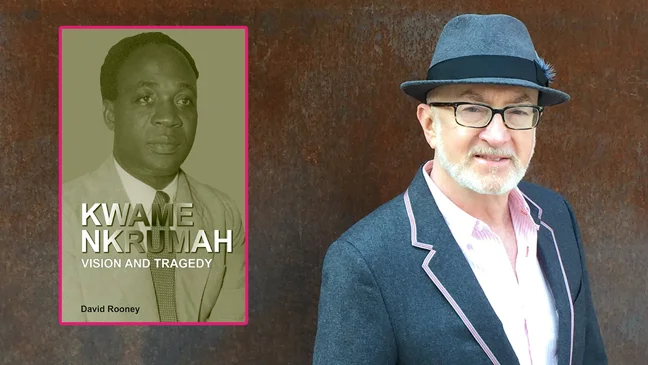
There are some names in African history you can’t whisper. You say them out loud and the room changes. Conversations pause. Faces tighten or soften. Someone nods slowly, someone else sighs. Whether you’re in Accra, Kampala, or Cairo, the effect is the same.
Kwame Nkrumah is one of those names.
He carries weight—hope, pride, controversy, disappointment, and a lingering sense of what could have been. He was a man who believed Africa could leap into modernity in a single bound, and who was willing to push, pull, and sometimes drag an entire nation along with him.
That is the man David Rooney sets out to examine in Kwame Nkrumah: Vision and Tragedy, a biography that refuses to turn its subject into either a saint or a monster.
👉 The edition I read is available here:
Kwame Nkrumah: Vision and Tragedy by David Rooney (Amazon)
From Nkroful to the Center of History
Nkrumah’s story does not begin with power—it begins with possibility.
Born in Nkroful, a small village in colonial Ghana (then the Gold Coast), Nkrumah was not groomed for leadership by wealth or royalty. He was shaped instead by colonial limitation, where ambition had to fight for air. Yet even early on, there was something restless about him—a sense that the world he inherited was far too small.
His education at Achimota School placed him among some of the sharpest minds of the era, but Ghana could not contain his curiosity. He left for London and later the United States, studying at Lincoln University, where his education went far beyond lecture halls.
In America, Nkrumah did not simply earn degrees—he absorbed ideas. Pan-Africanism. Black internationalism. Anti-colonial theory. He surrounded himself with thinkers and activists who believed Africa’s liberation was inevitable, not optional.
By the time he returned home, he was no longer just educated. He was dangerous—to colonial authority and cautious elites alike.
Politics of the Masses, Not the Tea Table
When the United Gold Coast Convention (UGCC) invited Nkrumah to serve as general secretary, they likely expected a disciplined organizer. What they got instead was a political force of nature.
The UGCC was cautious, elite, polite. Nkrumah wanted noise. He wanted crowds. He wanted farmers, traders, dockworkers—people who had never been invited into the political conversation—to see independence as their struggle.
He transformed the movement, but he also outgrew it.
Unable to push his radical agenda within conservative limits, Nkrumah broke away and formed the Convention People’s Party (CPP). Its message was simple and explosive: Self-government now.
The slogan spread like fire. So did fear.
The colonial government arrested him, assuming prison would quiet the movement. Instead, it amplified it. From behind bars, Nkrumah won elections. From confinement, he became unavoidable.
In 1957, Ghana became the first sub-Saharan African nation to gain independence.
And at the center of it all stood Nkrumah.
The Vision Expands—and Cracks
Independence did not satisfy Nkrumah. It accelerated him.
His dreams moved beyond Ghana toward Africa itself—one government, one military, one voice on the global stage. At home, he launched an ambitious industrialization program meant to transform Ghana into a socialist economic powerhouse.
Factories rose. State farms multiplied. Plans multiplied faster.
But reality refused to cooperate.
Many of these projects failed. The economy strained under the weight of rapid development. While Nkrumah financed liberation movements across Africa—convinced Ghana’s fate was tied to the continent’s freedom—ordinary Ghanaians faced rising prices and growing frustration.
As pressure mounted, Nkrumah withdrew inward. Surrounded by loyalists and shaken by multiple assassination attempts, he introduced the Preventive Detention Act, allowing imprisonment without trial.
The revolutionary became suspicious. The liberator became feared.
1966: The Silence After the Applause
The end came quietly.
In 1966, against widespread warnings, Nkrumah left Ghana for a peace mission to Hanoi. Two days later, the military struck. The coup succeeded. Nkrumah never returned to power.
He spent his final years in exile in Guinea, still writing, still thinking, still believing in African unity.
His dream survived him—even as his reputation fractured.
What This Book Gets Right—and Wrong
David Rooney’s Kwame Nkrumah: Vision and Tragedy is not a worshipful biography. It is analytical, detailed, and often unsparing. Rooney examines Nkrumah’s ideological commitments—scientific socialism, Pan-African unity, anti-imperialism—and places them within the geopolitical realities of the Cold War.
The chapters on foreign policy, socialism, and Nkrumah’s final years are especially illuminating. Rooney connects Nkrumah’s hardening stance toward the West to events like the assassination of Patrice Lumumba and covert foreign interference in African politics.
However, the book must be read critically.
Many of Rooney’s sources originate from the military regime that overthrew Nkrumah—hardly neutral narrators. Claims that Nkrumah did not write his own books feel convenient rather than conclusive. His role in founding the Organization of African Unity is noticeably downplayed, with greater credit given to Emperor Haile Selassie.
Perhaps most striking is how lightly the book treats colonialism itself. The violence, exploitation, and economic distortion that made independence necessary are often reduced to background noise.
Still, Rooney succeeds in one crucial way: he restores Nkrumah’s humanity. This is not a mythic hero, nor a cartoon dictator, but a complex man shaped by ambition, fear, brilliance, and contradiction.
👉 You can explore the book here:
Kwame Nkrumah: Vision and Tragedy – Amazon Edition
Why Nkrumah Still Matters
What lingers after reading this book is not agreement or disagreement—it’s recognition.
Over fifty years later, Africa is still debating unity, economic independence, and political sovereignty. The questions Nkrumah asked remain unanswered. His vision may have outpaced his methods, but it has not been replaced.
History, as Rooney reminds us (perhaps unintentionally), is never clean. It is layered with bias, power, and perspective. This book offers one version of Nkrumah’s life—but no single book can contain him.
As readers, we are obligated to read more, compare more, and think deeper.
Final Verdict
Kwame Nkrumah: Vision and Tragedy is informative, readable, and deeply thought-provoking—but it is not definitive.
It is best approached as a starting point rather than a final judgment. Rooney captures the scale of Nkrumah’s ambition and the cost of his failures, even when his framing feels uneven.
If you are interested in Ghana’s history, African political thought, or the burdens of leadership in post-colonial states, this book is worth your time.
👉 If you’d like to read the same edition I did:
Kwame Nkrumah: Vision and Tragedy on Amazon
Because Kwame Nkrumah’s story—his vision and his tragedy—cannot be contained in one book. And perhaps it shouldn’t be.
Forward ever. Backward never.