 English
 French
 German
 Russian
 中文
中文

Every Man Is a Race — The Most Poetic Rebellion Against Identity Boxes
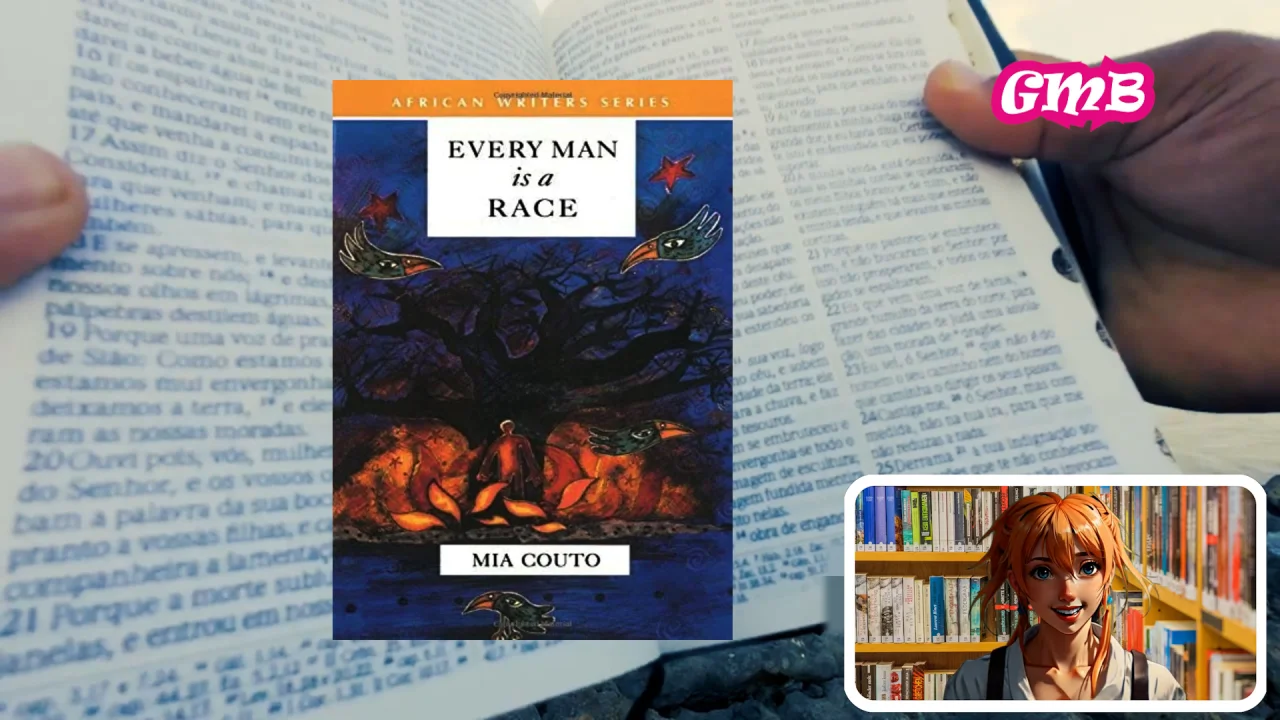
Imagine a man walks into a police station.
Dusty shoes. Bird cage in hand. Calm as a Sunday afternoon.
The officer looks up and asks the standard question: “Race?”
The man doesn’t hesitate.
“My race,” he says, “is me. John the Birdman.”
The officer frowns. “Explain yourself.”
“My race is me myself. A person is an individual humanity. Every man is a race.”
I paused when I read that.
Because in that moment, it didn’t feel like fiction. It felt like rebellion. A quiet, poetic rebellion against every form, every box, every checkbox that demands we shrink ourselves into categories.
That’s when I knew this wasn’t going to be an ordinary short story collection.
That’s when I stepped into the strange, surreal, beautiful world of Every Man is a Race by Mia Couto.
And trust me — John the Birdman is only the beginning.
What Kind of Novel Is This?
This is a magical realist, political, reflective short story collection about identity — personal, racial, and national — in postcolonial Africa.
Tone: quiet, lyrical, occasionally unsettling
Pace: slow, deliberate
Themes: identity, postcolonial disillusionment, power, freedom, class, madness, belonging
This book is for readers who:
-
Love symbolism more than straight answers
-
Enjoy stories that feel told around a fire rather than structured in neat chapters
-
Appreciate African literature that experiments boldly
This book is NOT for readers who:
-
Need fast plots and constant action
-
Prefer clear moral heroes and villains
-
Get frustrated when a story leaves space for interpretation
👉 The edition I read is available here:
Every Man is a Race (Amazon Edition)
Why This Story Matters (The Emotional Core)
On the surface, these are just 18 short stories.
But beneath that surface is a quiet interrogation:
What happens after the revolution?
Who are we when the labels fall away?
Does freedom really free us?
Couto isn’t simply writing about Mozambique. He’s writing about every nation that fought for liberation only to discover that power doesn’t disappear — it just changes hands.
In stories like The Flagpoles of Beyondwards, a father tells his son:
“Now I'm a white man's servant. What will become of me after?”
“After, there will be freedom, Father.”
“Nonsense, son… their hoe is a musket.”
That line stayed with me.
Because it suggests something uncomfortable: sometimes revolutions create new masters. Sometimes the oppressed rehearse the same script when they finally hold the gun.
And then there’s Whites — one of the sharpest pieces of satire in the collection. A room full of intellectuals debate African authenticity in polished language… until a man storms in with a goat and accuses them of being “whites in disguise.”
It’s absurd. It’s funny. It’s devastating.
Couto’s message isn’t that race doesn’t matter. It’s that identity is too complex to be reduced to slogans.
“Every man is a race” isn’t just a clever title.
It’s a worldview.
We are contradictions. We are layered. We are more than our categories.
And in a world still obsessed with dividing people into sides, this book feels urgently relevant.
A Glimpse of the Story (Minimal, No Spoilers)
The collection opens with Rosa Caramela — a hunchbacked man who falls in love, loses everything, and is quietly labeled mad.
Another story takes the form of a letter to God from a mine worker haunted by guilt after a Russian woman, Nadia, witnesses the horrors of slave labor.
In The Rise of João Bate-Certo, a boy builds a ladder tall enough to reach the city skyline — a metaphor so innocent and absurd that you can’t help but root for him.
There are fishermen, revolutionaries, forgotten workers, dreamers, and ghosts of colonialism lingering in every corner.
No dragons. No spaceships.
Just people trying to make sense of freedom, dignity, and survival.
Who This Book Is Perfect For
You’ll enjoy this novel if:
-
You like books that make you pause mid-sentence
-
You enjoy lyrical prose and symbolic storytelling
-
You read fiction to think, not just escape
You might struggle with this book if:
-
You prefer fast-paced plots
-
You need tidy endings
-
You dislike stories that feel like parables
👉 If this sounds like your kind of book, you can find it here:
Every Man is a Race (Amazon Edition)
My Honest Verdict
This isn’t an easy book.
Some stories will confuse you. Some will feel unfinished. Some will require rereading.
But that’s also its strength.
Couto’s prose — even in translation by David Brookshaw — carries rhythm. It feels spoken, almost oral in texture. There’s very little dialogue. Instead, the stories unfold like memories passed down through generations.
What worked:
-
The poetic language
-
The political subtlety
-
The bold satire in stories like Whites
-
The emotional weight of The Russian Princess
What didn’t:
-
At times, the abstraction can distance you emotionally
-
You may not immediately grasp what’s happening in certain scenes
This isn’t a perfect collection.
But it’s an honest one.
And those are rare.
Final Thoughts & Recommendation
When I finished Every Man is a Race, I didn’t feel entertained.
I felt unsettled.
I kept thinking about John the Birdman standing in that police station, calmly refusing to shrink himself into a racial box.
I kept thinking about the father who doubts that freedom will change anything.
I kept thinking about a goat interrupting intellectual hypocrisy.
This is a slim book — barely over 100 pages — yet it carries the density of something much larger. It reminds me why African literature matters. It experiments. It resists. It refuses to simplify itself for comfort.
If you’re looking for something lyrical, political, surreal, and deeply human — this is a brilliant choice.
Just bring your patience.
And maybe… a goat.
👉 If you’d like to read the same edition I did, here’s the link:
Every Man is a Race (Amazon Edition)