 English
 French
 German
 Russian
 中文
中文

Look Where You Have Gone to Sit: Ghana’s Poetic Uprising You Can’t Ignore
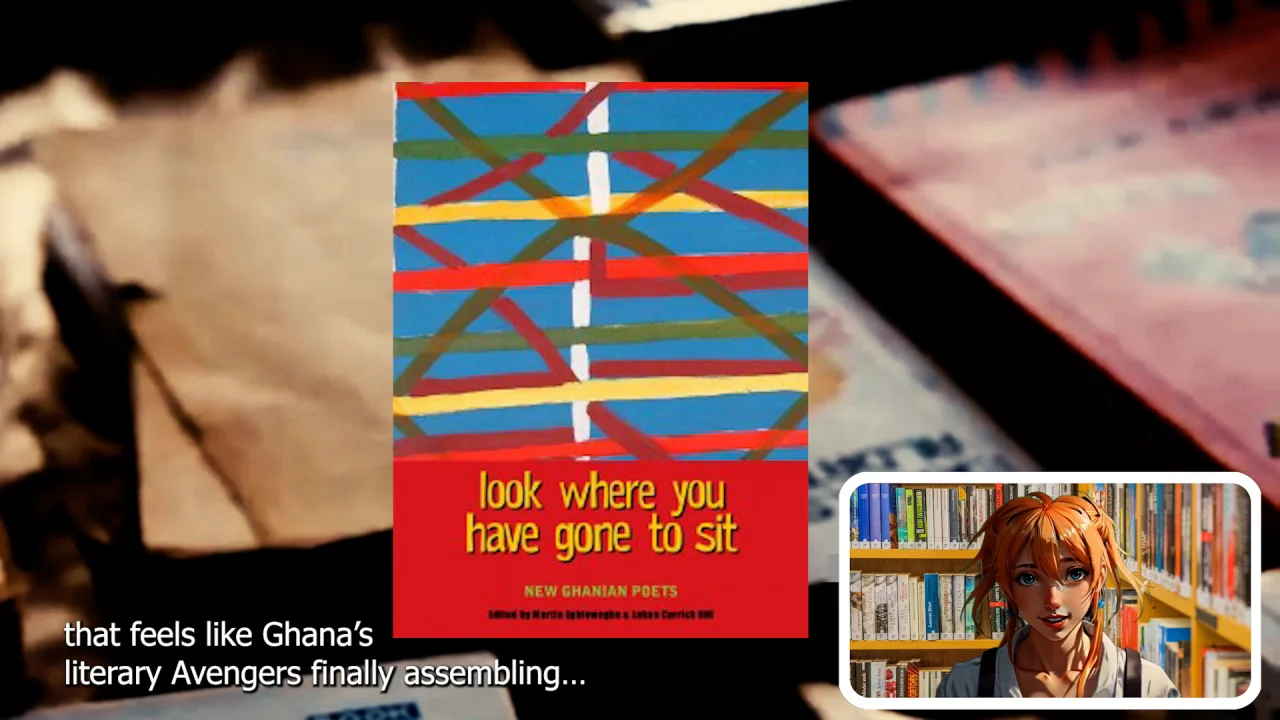
Have you ever been so determined to write poetry that you start doing it in catacombs? Literal underground poetry? That’s exactly the vibe of Look Where You Have Gone to Sit—an anthology that feels like Ghana’s literary Avengers finally assembling… after being ghosted by the publishing industry for decades.
At just 63 pages, this powerhouse anthology, edited by Martin Egblewogbe and Laban Carrick Hill, isn’t just a collection of poems—it’s a full-blown literary rebellion. Young Ghanaian poets have crawled out of their artistic caves, brushed off the cobwebs, and finally taken a seat at the table. And what a poetic banquet it is. Don’t let the page count fool you; this is a movement in verse.
The Premise: A Line Packed With Attitude
The title itself—Look Where You Have Gone to Sit—is loaded if you’re Ghanaian. Think auntie-style judgment with a splash of sarcasm. Possibly inspired by Atukwei Okai’s 999 Smiles, the phrase conjures an older generation throwing metaphorical stones at the new wave of poets. But are they criticizing, or finally offering a hand? The anthology itself provides the answer: a mix of challenge, defiance, and hope.
Cooking Poetry in Catacombs
This anthology is the result of years of poetic fermenting in the hidden corners of Ghana—catacombs, crevices, and subterranean cloisters. Why? Because Ghana’s mainstream media doesn’t make space for poetry. Political scandals, celebrity gossip, wedding reports—you get all that, but poetry? Rarely.
So these 20 poets took matters into their own hands. The result is 36 experimental, revolutionary, unapologetically Ghanaian poems. Each one refuses to play small.
Let’s Talk Poems
The anthology opens with Darko Antwi’s We Blacks, a celebration of African diversity. Forget trying to unite all of Africa under one banner. Antwi embraces differences—Apraku, Ngozi, Dibango, Makeba, Yemi—and celebrates the beauty in our variety, much like an Ashanti forest in full bloom.
Then comes Nana Nyarko’s No Canto, which hits you with the reality of being a poet in a place where publishing doors are often closed. Dormant cages, brittle images, fallen wings—her words are a wake-up call to the literary dryness of the Ghanaian scene.
Nyarko’s don’t you tell or you’ll die is even more confronting, tackling a culture of enforced silence in the face of injustice. Her lines:
"I am berated for being repulsed by the men who stole my early days,
for saying, a-b-c- to -f-a-r-k-u, (in silence)
when they ask 'how are you?'"
Devastating, experimental, unforgettable.
Trotros and the Chaos of City Life
Kwabena Danso’s Trotro Chronicles transports you to a crowded trotro, packed with sweaty passengers, hawkers shouting in multiple languages, and the chaos of city life. His poem blends pidgin, French, Twi, Ga, Hausa, and English into a linguistic kenkey stew:
"Imliedzɔ ei! Ice... pure water for sweating brows and teary eyes
An entire drive through super market opens up before you
Wetin you dey search from plantain chips to brand new shoes
Dog chains, dogs, dolls, bofrot, CDs to car tools"
Other poems, like Novisi Dzitrie’s Ol’ Driver Grand-Papa and Crystal Tettey’s Kokompe to Lapaz, echo the loud, chaotic, multilingual rhythm of the city. In Theresah Patrine Ennin’s A Woman in a Taxi, the city becomes lonely and paranoid, capturing the tension of urban Ghanaian life.
Science, Stars, and Sarcasm
Co-editor Martin Egblewogbe’s poems bring his physics background to poetry. In A Cigarette with Sonia as the Fan Went Round and Round, a simple smoke breaks into a meditation on loneliness and existential dread. In Death and Friday Night, Ananse stories meet funerals in a wildly imaginative blend that’s both playful and philosophical.
Na Waa, Susan Boyle, and the Beat of the Drums
Bernard Akoi-Jackson’s Na Waa! is a single-word-per-line sigh that mirrors the frustrations of everyday life in Ghana: Na wa oo. Mercy Ananeh-Frempon’s Susan Boyle reminds us not to judge by appearances, while Fredua-Agyeman’s Finding My Voice and Nii Lantey’s Obunkutu let you feel the rhythms of history and the beat of the drums, connecting past, present, and future.
Totimeh’s Parting Words
Teddy Totimeh closes the anthology with poems that whisper and shout about seeing “the colour in the squalor” and “the humour in the clamour.” Amidst suffering, there’s hope—Elavanyo—better days are ahead.
Why This Anthology Matters
Look Where You Have Gone to Sit isn’t just poetry—it’s protest, philosophy, journalism, jazz, and prayer rolled into one. Every poet here takes risks: experimental structures, bold topics, local languages. Everything that couldn’t be published in newspapers found a home here. The result is one of Ghana’s most important 21st-century anthologies. Some poems confront pain; others celebrate survival. All demand to be heard.
The Editors: Architects of a Literary Table
Martin Egblewogbe is a physicist, writer, literary organizer, radio host, and teacher who has done more for Ghana’s literary scene than most realize. Laban Carrick Hill bridges Ghana and the U.S., empowering youth and blending art, history, and education through his work. Together, they built a platform that tells young Ghanaian writers: You matter. Your voice matters. Here, take a seat.
Final Thoughts
So… look where they have gone to sit—right at the table of African literature. And I hope they never get up. This anthology is for anyone who loves poetry that’s unafraid, experimental, and unapologetically local. It’s for readers who want to see Ghanaian voices rise, loud and proud.