 English
 French
 German
 Russian
 中文
中文
The Hilarious Apocalypse: A Deep Dive into Kurt Vonnegut’s Cat’s Cradle
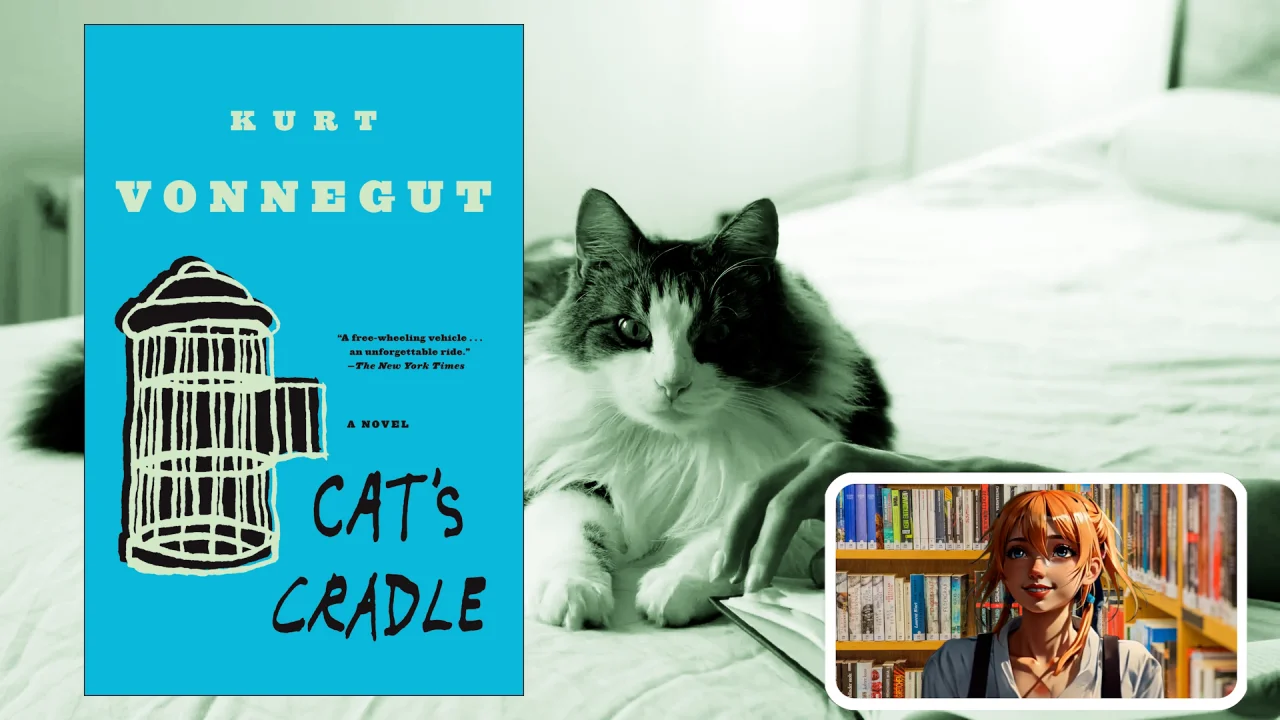
A Moment That Made Me Pause
I didn’t plan to stumble into a global apocalypse that day. I was just minding my own business, trying to write a little something about ordinary people doing ordinary things when the world went nuclear—metaphorically, thanks to Kurt Vonnegut. What started as curiosity about life during the Hiroshima bombing led me straight into the bizarre, brilliant, and slightly terrifying universe of Dr. Felix Hoenikker—the man who helped invent the atomic bomb and apparently thought about human interaction like a cat thinks about paying taxes.
Felix is dead, but his legacy lives on through his children—Newt, Angela, and Frank—and a tiny crystalline substance called ice-nine. One drop of it and the world freezes. Literally. And thanks to Felix’s casual “gifting,” the apocalypse is ready to roll.
By the time I closed the book, I was laughing nervously, wincing at humanity’s absurdity, and wondering how Vonnegut managed to make the end of the world feel both hilarious and horrifying.
What Kind of Novel Is This?
Cat’s Cradle is a satirical dystopian novel with a darkly humorous lens on science, religion, and human folly.
-
Tone: Reflective, cynical, and disturbingly funny
-
Pace: Moderate, with moments of absurdity that hit like punchlines
-
Themes: The dangers of science without ethics, the power of comforting lies, American imperialism, global inequality, and mankind’s stubborn foolishness
This book is for readers who:
-
Love dark humor that makes you think
-
Enjoy satire and absurdist fiction
-
Want stories that question human nature and society
This book is NOT for readers who:
-
Prefer straightforward, fast-paced thrillers
-
Need clear-cut heroes and villains
-
Avoid open-ended or philosophical conclusions
👉 Grab the edition I read here on Amazon.
A Glimpse of the Story
Our narrator, John—or Jonah, because why not be biblical while covering the end of the world—sets out to interview people connected to Felix Hoenikker. Through Dr. Asa Breed, he learns about ice-nine, a substance so dangerous it could turn all water on Earth into solid ice.
Felix’s children each receive a portion of ice-nine, and their lives—and the world—spiral into chaos. Frank becomes the ruler of the chaotic Caribbean island San Lorenzo, Newt falls in love under unusual circumstances, and Angela uses hers to snag a husband. Meanwhile, Bokononism, a fake religion, dominates the island’s culture, highlighting humanity’s craving for comforting lies—even when explicitly told they’re lies.
Disasters unfold quickly: ice-nine spreads, solidifying seas, rivers, and people. By the end, John witnesses the frozen aftermath of human folly, guided by the darkly comic commentary of Bokonon, whose final message is brutally honest: humanity has little hope unless we recognize our own foolishness.
Analysis & Review
Kurt Vonnegut’s genius lies in his ability to be simultaneously hilarious and horrifying. Cat’s Cradle skewers:
-
Science and Ethics: Felix Hoenikker invents a world-ending substance without consideration for consequences. It’s a sharp reminder of the double-edged nature of human ingenuity.
-
Religion: Bokononism exemplifies humanity’s need to cling to comforting lies. Vonnegut shows how faith can be manipulated, not for truth, but for peace of mind or control.
-
Politics and Society: From McCarthyism echoes in America to San Lorenzo’s puppet government, Vonnegut critiques power, inequality, and imperialism.
-
Human Folly: Ultimately, the novel reflects on mankind’s capacity for self-destruction—building miracles that become monsters and lies that become lifelines.
The book’s brilliance is in its tone: even as the world freezes, the absurdity keeps you laughing. The satire is clever, the observations timeless, and the narrative voice uniquely Vonnegut: cynical, witty, and heartbreakingly human.
Weaknesses: Some readers may find the book’s moral ambiguity and open-endedness frustrating. The narrative can feel disjointed at times due to Vonnegut’s episodic style. But these quirks are also part of its charm.
Who Should Read This Novel
You’ll enjoy Cat’s Cradle if you:
-
Love books that mix humor with deep social critique
-
Appreciate absurdist storytelling and satirical commentary
-
Read fiction to reflect on humanity, not just escape
You might struggle with this book if you:
-
Prefer linear, fast-paced plots
-
Need traditional heroes or clear resolutions
-
Dislike philosophical or satirical ambiguity
👉 Check out this edition on Amazon if this sounds like your kind of read.
Final Thoughts & Recommendation
Cat’s Cradle is one of those rare novels that sticks with you long after the last page. It’s a cautionary tale wrapped in laughter, a satire that cuts deep while keeping you entertained. Vonnegut doesn’t just tell a story; he holds up a mirror to humanity—its brilliance, its absurdity, and its capacity for destruction.
Whether you’re drawn to its biting humor, its social critique, or its philosophical undertones, this book will make you question the ways we handle science, religion, and power. And yet, it leaves room for a faint glimmer of hope: maybe recognizing our own foolishness is the first step toward avoiding the next catastrophe.
If you want a novel that makes you laugh, wince, and think all at once, Cat’s Cradle is essential reading.
👉 Pick up the edition I loved here and discover Vonnegut’s hilarious, haunting vision of the end of the world.