 English
 French
 German
 Russian
 中文
中文

A Curse That Makes You Walk Forever: The Strange Journey of Burning Grass
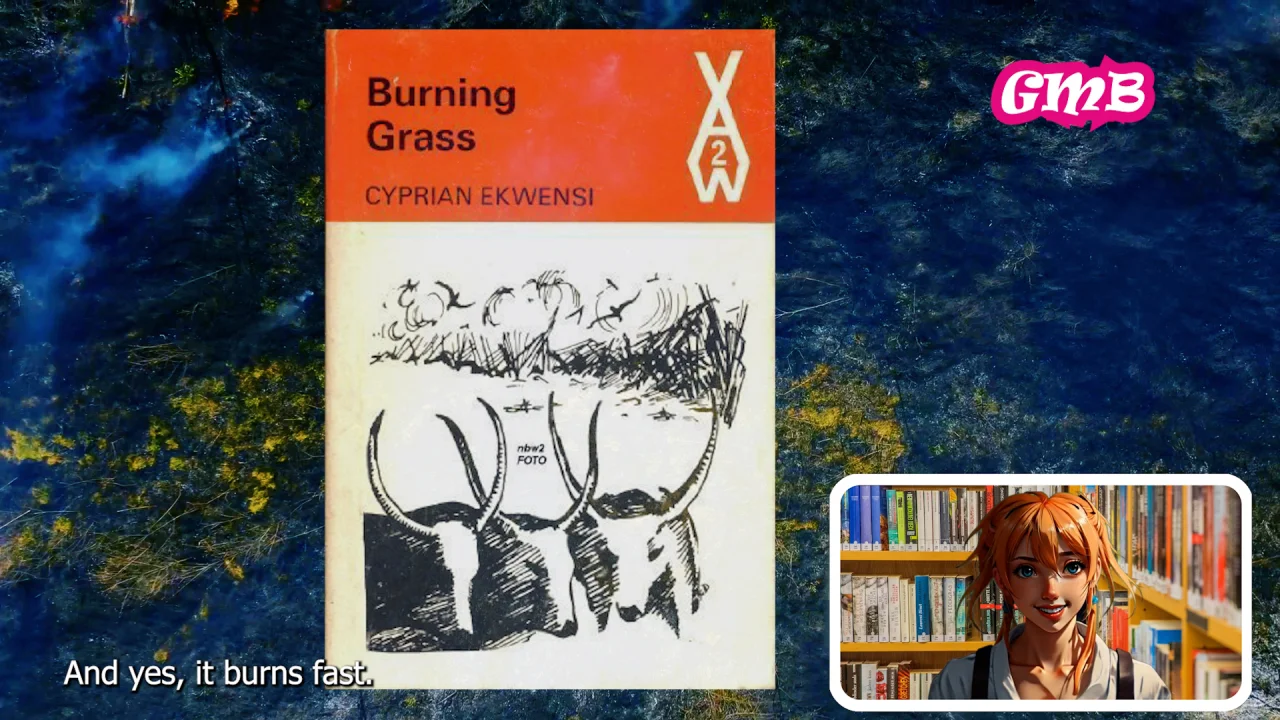
There’s a moment early in this story that made me pause and laugh at the same time.
Imagine you're out in the open fields with your cattle. Life is calm. The sun is shining, the cows are doing their usual cow business, and the grass is behaving itself.
Then suddenly—bam.
A man comes charging through the field, whipping a girl like he’s chasing an outlaw in a Western film.
Now, if you’re Mai Sunsaye—respected Fulani elder, healer, and leader—you don’t stand there watching the drama. You do something about it. So he trades some of his cows for the girl and sends the angry pursuer packing.
Just like that, the girl—Fatimeh—is free.
Problem solved, right?
Not quite.
Because the moment Fatimeh enters Mai Sunsaye’s compound, his sons start behaving like contestants on the Fulani version of The Bachelor. The youngest, Rikku, falls for her immediately. And she seems to like him too.
But then—plot twist.
Fatimeh runs away with the wrong brother.
She elopes with Hodio.
Rikku is left heartbroken, confused, and emotionally wrecked.
And just when you think the family drama is enough… a magical bird appears.
This bird carries a mysterious curse called sokugo:
“a magic that turned studious men into wanderers, that led husbands to desert their wives, Chiefs their people and sane men their reason.”
The curse takes hold of Mai Sunsaye.
And suddenly, the respected leader becomes a wanderer.
His home burns down.
His family scatters.
And he starts walking.
And walking.
And walking.
That strange, restless journey is the beating heart of Burning Grass by Cyprian Ekwensi.
👉 The edition I read is available here:
https://amzn.to/4oHEjmy
What Kind of Novel Is This?
Burning Grass is a fast-paced cultural adventure about movement, family, and the restless spirit of nomadic life.
Tone: adventurous, reflective, occasionally mystical
Pace: fast
Themes: nomadism, family, identity, restlessness, tradition
Despite its short length—just over a hundred pages—the story never slows down. Every few pages, someone is leaving, chasing, searching, or escaping.
This book is for readers who:
-
Enjoy novels rooted in African culture
-
Like stories that feel like oral storytelling traditions
-
Appreciate quick, energetic reads
This book is NOT for readers who:
-
Want dense literary prose
-
Prefer slow psychological introspection
-
Need tightly structured modern plots
👉 You can check out the same edition here:
https://amzn.to/4oHEjmy
Why This Story Matters
What stayed with me most after finishing Burning Grass wasn’t the adventure.
It was the idea of restlessness.
The magical illness, sokugo, makes people abandon their homes and wander endlessly. It turns responsible men into drifters and leaders into strangers.
And the more I thought about it, the more it felt familiar.
Because sokugo doesn’t just belong to folklore.
Think about how many people today feel the same pull—the urge to leave, to move, to escape something they can’t quite name. People abandoning careers, relationships, cities, identities.
In that sense, sokugo feels like a metaphor for the modern condition.
Ambition.
Anxiety.
Wanderlust.
Midlife crisis.
All wrapped in the form of a magical bird.
But the novel doesn’t dwell heavily on philosophy. Instead, it moves quickly through events, letting the meaning emerge naturally through the journey.
And that journey is full of surprises.
One moment Mai Sunsaye is chasing the magical bird that cursed him.
The next he’s searching for his son Jalla.
Then he’s trying to reunite his scattered family.
Meanwhile, Fatimeh—the girl whose freedom started everything—transforms into something almost mythical.
She becomes a Fulani legend:
-
She wears only white
-
Travels in the evenings
-
Moves with a lion
-
And owns her own herd of cattle
At this point she feels less like a person and more like folklore walking through the savannah.
Eventually, she reunites with Mai Sunsaye—and ironically, she’s the one who cures him of the very curse that caused all the chaos.
Life really does move in circles.
A Glimpse of the Story (No Spoilers)
At its core, Burning Grass follows a respected Fulani leader whose life is overturned by a mysterious curse.
The sokugo forces him into a restless journey across the landscape, while his scattered family members search for him—and for each other.
Along the way, rivalries resurface, old enemies return, and each character is forced to confront their place within Fulani tradition.
It’s a story about wandering.
But also about finding your way home.
The Culture of the Fulani World
One of the most powerful things about Burning Grass is how vividly it portrays the life of Fulani cattle herdsmen.
The dust.
The cattle.
The long migrations.
The honor codes.
Everything feels alive.
Ekwensi doesn’t just describe the culture—he lets it move through the story.
“This story portrays the life, struggles, and travails of cattle herdsmen and their aversion towards city life and its sedentariness.”
The contrast between nomadic life and settled urban life quietly runs throughout the novel.
For the characters in this story, the city represents restriction. Permanence. A loss of identity.
Movement is freedom.
But sokugo complicates that idea.
Because what happens when freedom turns into rootlessness?
Who This Book Is Perfect For
You’ll enjoy this novel if:
-
You like African literature rooted in culture and tradition
-
You enjoy stories told in a lively, oral storytelling style
-
You prefer books that move quickly
You might struggle with it if:
-
You prefer slow literary fiction
-
You need deeply developed character psychology
-
You dislike episodic storytelling
👉 If this sounds like your kind of book, you can find it here:
https://amzn.to/4oHEjmy
My Honest Verdict
This isn’t a perfect novel—but it’s a memorable one.
What worked for me:
-
The pacing is incredibly energetic
-
The cultural setting feels vivid and authentic
-
The storytelling style feels like listening to a folktale around a fire
What didn’t work as well:
-
Some plot developments happen very quickly
-
Certain characters feel more symbolic than deeply developed
Still, the story remains entertaining because of how smoothly the events unfold.
“Events take place at a fast pace and though the reader could make some predictions, because things fitted in so perfectly, it was still a pleasure to read them.”
And Mai Sunsaye himself is a fascinating hero.
He’s wise. Respected. A healer.
But even he isn’t immune to forces beyond his understanding.
Which raises an interesting question:
“One is tempted to ask which great medicine man cannot fight sokugo charms or even show any form of magic whiles on his journeys?”
That flaw makes him human.
And that humanity keeps the story grounded even when magical elements appear.
About the Author
Cyprian Ekwensi had one of the most interesting careers in African literature.
Born in 1921 in Minna, Northern Nigeria, he studied at Government College Ibadan, Achimota College in Ghana, and later pharmacy in Lagos and London.
Before becoming widely known as a writer, he worked as:
-
a forestry officer
-
a teacher
-
a pharmacist
-
a broadcaster
And he wrote constantly.
His storytelling style reflects his early career as a pamphleteer—fast, vivid, and episodic.
His novel People of the City (1954) became one of the earliest major novels published by a Nigerian author. Another famous work, Jagua Nana, cemented his reputation.
But Burning Grass remains one of his most energetic and culturally rich works.
As one observation about the novel puts it:
“Ekwensi employed the traditional narrative style and it suited the story very well.”
And it really does.
The rhythm of the prose feels closer to oral storytelling than to modern literary fiction.
Final Thoughts
Burning Grass is a story about movement.
Not just across land—but across identity, family, and tradition.
Mai Sunsaye’s wandering may begin as a magical curse, but it slowly becomes something deeper: a journey toward restoring balance in his life and among his people.
What starts as a strange tale about a cursed bird turns into a portrait of Fulani life—its beauty, its struggles, and its deep connection to movement and freedom.
And maybe that’s why the story still resonates.
Because somewhere inside many of us, there’s a little sokugo too.
That restless feeling that keeps telling us to keep walking.
👉 If you’d like to read the same edition I did, you can find it here:
https://amzn.to/4oHEjmy