 English
 French
 German
 Russian
 中文
中文

Big Bishop Roko and the Altar Gangsters – A Novel That Mutates Your Brain on Purpose
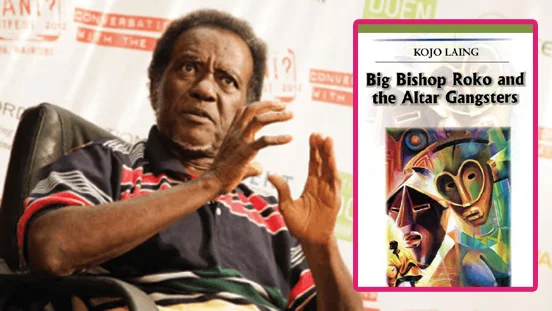
Imagine opening a novel and being told, almost immediately, that an Anglican bishop is experimenting with shark sperm to genetically redesign humanity.
Now imagine deciding to continue reading.
That was my entry point into Big Bishop Roko and the Altar Gangsters — and honestly, once you accept that this book has absolutely no intention of behaving like a normal novel, the ride becomes strangely exhilarating.
Set in a warped, almost hallucinatory version of 1986 Gold Coast City, Kojo Laing throws us into a world where religion, science, power, and absurdity collide without apology. This is not historical fiction. It’s not conventional science fiction either. It’s something far more slippery — a satirical, philosophical experiment disguised as a novel.
👉 The edition I read is available here:
Big Bishop Roko and the Altar Gangsters on Amazon
What Kind of Novel Is This?
This is a satirical science-fiction novel soaked in Gothic excess, religious parody, and Ghanaian cultural texture.
-
Tone: Darkly humorous, irreverent, confrontational
-
Pace: Slow, repetitive, deliberately exhausting
-
Core idea: Power, belief, mutation, and the absurdity of human attempts to “fix” existence
This book is for readers who:
-
Enjoy experimental African literature
-
Don’t mind being confused before being enlightened
-
Like novels that attack religion, science, and authority at the same time
This book is not for readers who:
-
Want a fast, plot-driven story
-
Need clear heroes and villains
-
Prefer tidy explanations and linear storytelling
Why This Story Matters (Even When It Makes No Sense)
Strip away the genetic chaos, the two-headed Pope, and the bishop with a mouth big enough to hide farm equipment, and Big Bishop Roko and the Altar Gangsters is really asking one relentless question:
Why do humans keep trying to improve the world without understanding themselves first?
Bishop Roko believes mutation is liberation. The Pope and the Archbishop believe hierarchy should survive mutation — with the rich evolving first and the poor waiting a millennium. Both sides claim moral authority. Both sides are ridiculous. And that’s the point.
Laing isn’t mocking faith alone. He’s mocking blind certainty — religious, scientific, political, and intellectual. His satire suggests that whether we wear lab coats or clerical robes, we’re often just dressing up the same hunger for control.
What stayed with me long after finishing this book wasn’t the plot (which dissolves and reforms constantly), but the feeling that Laing was daring the reader to admit how fragile our ideas of progress really are.
A Glimpse of the Story (No Spoilers)
At its core, the novel presents:
-
A religious leader who believes mutation will free humanity
-
A global religious power structure fighting back with its own twisted plan
-
A looming genetic war that exposes how absurd moral authority becomes when taken too seriously
The story unfolds less like a straight narrative and more like a ritual, looping back on itself, repeating images, words, even entire passages — as if Laing wants to beat meaning into you through rhythm rather than logic.
Language as Chaos (And Why It Works)
Kojo Laing doesn’t just bend language — he rebuilds it.
He invents words like “theodicides” and “crucificionado,” folds Ghanaian speech patterns into English, and uses repetition so aggressively that it starts to feel hypnotic. Bishop Roko’s mouth, for example, is described so often it becomes symbolic rather than physical — a grotesque emblem of unchecked power and consumption.
Yes, it’s frustrating.
Yes, it’s dense.
And yes, sometimes it feels like Laing is daring you to quit.
But if you surrender to the rhythm, the language becomes the experience.
👉 You can find this same edition here:
Buy Big Bishop Roko and the Altar Gangsters on Amazon
Who This Book Is Perfect For
You’ll enjoy this novel if:
-
You like books that challenge religion and philosophy
-
You enjoy African literature that refuses Western narrative rules
-
You read fiction to think, not just to relax
You might struggle with this book if:
-
You prefer clean storytelling
-
You dislike repetition
-
You want easy answers
My Honest Verdict
This isn’t a perfect novel — but it’s a fearless one.
What worked:
-
The audacity of the ideas
-
The originality of the language
-
The unapologetic satire
What didn’t:
-
Excessive repetition
-
Narrative opacity that sometimes feels unnecessary
Why I still recommend it:
Because very few novels are this willing to risk alienating the reader in order to say something bold. Kojo Laing doesn’t negotiate with your comfort — and that integrity matters.
Final Thoughts & Recommendation
Big Bishop Roko and the Altar Gangsters is not a book you consume — it’s a book you survive.
It’s messy, excessive, hilarious, irritating, and occasionally brilliant. And in a literary landscape full of safe, predictable stories, Laing’s refusal to behave feels almost radical.
If you’re curious about African literature that breaks rules, mocks authority, and treats language like raw material rather than a fixed system, this novel deserves your time.
👉 If you want to read the same edition I did, here’s the link:
Big Bishop Roko and the Altar Gangsters on Amazon
Optional: Best Format to Read This Book
Paperback — you’ll want to flip back, reread passages, and physically wrestle with the text. Digital just doesn’t feel right for a book this confrontational.