 English
 French
 German
 Russian
 中文
中文

The Man Who Tried to Predict the End of Humanity (And Almost Got It Right)
There’s a moment when you realize this isn’t just science fiction anymore.
You’re reading, and suddenly it hits you: what if history really is predictable? What if everything—wars, revolutions, the rise and fall of nations—is just a pattern waiting to be solved?
That was the thought that stayed with me while reading the Foundation Trilogy by Isaac Asimov. Not the spaceships. Not the empire. But the quiet, unsettling idea that humanity might just be an equation.
And worse… that someone might already have solved it.
What Is The Foundation Trilogy About?
At its core, this is a science fiction epic—but not the kind you might expect.
This is a thought-driven, idea-heavy sci-fi series about the rise and fall of civilizations, and whether that collapse can be controlled.
-
Genre: Science Fiction / Political Sci-Fi
-
Tone: Intellectual, reflective, quietly intense
-
Pace: Moderate (driven by ideas more than action)
-
Themes: Power, knowledge, control, destiny, chaos, history
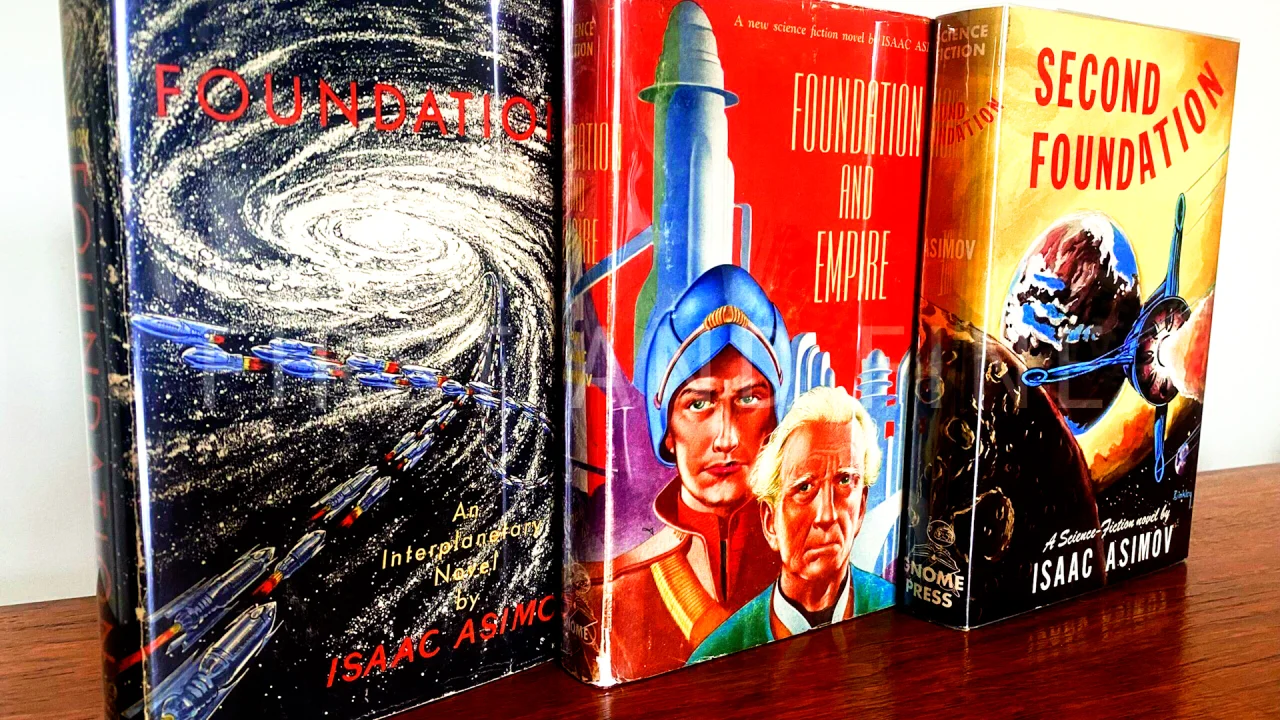
This trilogy includes:
-
Foundation (1951)
-
Foundation and Empire (1952)
-
Second Foundation (1953)
👉 The edition I read is available here:
https://amzn.to/44RKCNh
A Quick, No-Spoiler Summary
The story begins with Hari Seldon, a mathematician who develops a theory called psychohistory—a way to predict the future of large populations using mathematics.
And his prediction?
The Galactic Empire is going to fall. Completely.
Not only that—it will plunge humanity into 30,000 years of darkness.
Unless something is done.
So Seldon creates the Foundation: a group of scientists sent to the edge of the galaxy to preserve knowledge and shorten the coming dark age.
But things don’t go exactly as planned.
Because history, no matter how calculated… has a way of breaking its own rules.
Analysis & Review: Where This Trilogy Truly Shines
1. The Ideas Are the Real Main Characters
Let’s be honest—this isn’t a character-driven story.
You won’t get deeply emotional backstories or long internal monologues. Characters come and go, sometimes abruptly.
But that’s not the point.
The real protagonist here is history itself.
Asimov is asking:
-
Can human behavior be predicted?
-
Are we in control of our future—or just following patterns?
-
What happens when one unpredictable person changes everything?
These questions hit harder than any battle scene.
2. Power Isn’t What You Think It Is
One of the most fascinating parts of the trilogy is how it redefines power.
At first, it’s about knowledge. The Foundation survives because it understands technology better than everyone else.
Then it becomes politics.
Then psychology.
And eventually… something even more unsettling.
Power keeps shifting, evolving—just like it does in the real world.
3. The Mule: When the Equation Breaks
Without spoiling anything, there’s a moment in the second book where everything changes.
A single character—The Mule—enters the story and completely disrupts Seldon’s perfect mathematical predictions.
And that’s when the trilogy becomes something deeper.
Because suddenly, it’s no longer about certainty.
It’s about uncertainty.
And that tension—between order and chaos—is what makes this series unforgettable.
4. The Writing: Simple, But Effective
Here’s the honest truth:
Asimov’s prose is… plain.
No lyrical descriptions. No poetic flourishes.
Just clear, direct writing.
But strangely, it works.
Because the focus is always on the ideas. You’re not distracted—you’re thinking.
And in a story like this, that’s exactly what you want.
Why This Story Still Matters Today
This is what surprised me the most.
Despite being written in the 1950s, The Foundation Trilogy feels eerily modern.
We live in a world obsessed with:
-
Data
-
Predictions
-
Algorithms
-
Forecasting the future
And here’s Asimov, decades ago, asking:
What if we could predict everything… and still get it wrong?
That idea lingers.
Because no matter how advanced we become, there will always be a “Mule”—something unpredictable that breaks the system.
And that’s both terrifying… and comforting.
Who Should Read This Book?
You’ll enjoy this trilogy if:
-
You love big ideas over action scenes
-
You enjoy stories about politics, power, and strategy
-
You like books that make you think long after you finish
You might struggle with it if:
-
You prefer fast-paced, character-driven plots
-
You want emotional depth over intellectual depth
-
You need clear heroes and villains
👉 If this sounds like your kind of read, you can check it out here:
https://amzn.to/44RKCNh
My Honest Verdict
This isn’t a perfect trilogy—but it’s a foundational one. (No pun intended… okay, maybe a little.)
What worked:
-
The concepts are brilliant and timeless
-
The scope feels massive without needing action-heavy scenes
-
The unpredictability keeps you hooked
What didn’t:
-
Characters can feel distant or interchangeable
-
The writing style might feel too simple for some readers
And yet…
I’d still recommend it.
Because books like this don’t come around often.
Final Thoughts
I keep thinking about that original question:
What if history is predictable?
The **Foundation Trilogy doesn’t give you a clear answer. Instead, it does something better—it makes you sit with the uncertainty.
It reminds you that even the smartest plans can fail. That power is always shifting. And that one unexpected variable can change everything.
If you read fiction to escape, this might not be your book.
But if you read fiction to understand the world—and maybe question it a little more deeply—this trilogy is worth your time.
👉 If you’d like to read the same edition I did, here’s the link:
https://amzn.to/44RKCNh