 English
 French
 German
 Russian
 中文
中文

Search Sweet Country by Kojo Laing: A Linguistic Adventure Through 1970s Ghana
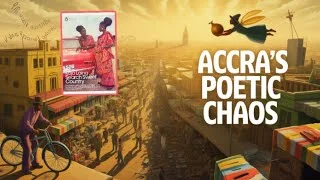
A Novel That Breaks All the Rules
What if I told you there’s a book where groundnut sellers literally carry words to their friends, bicycle repairers pump patience into tires, and buildings stare enviously at each other? No, this isn’t Alice in Wonderland. This is African literature at its most audaciously experimental.
Search Sweet Country by Kojo Laing is a novel that throws the rulebook out the window, does a backflip, and lands in a linguistic circus. Reading it is like stepping into a world where language itself is alive, mischievous, and endlessly inventive. If you’re ready to have your mind stretched and your expectations upended, buckle up.
👉 You can find Search Sweet Country here on Amazon.
Setting the Stage: Ghana, 1975
Laing sets his novel in Ghana in 1975, a time when the initial euphoria of independence had faded. Military leader Ignatius Kutu Acheampong ran the country with campaigns like Operation Feed Yourself and Operation Feed Your Industries – plans that sounded motivational on paper but often failed in practice. Corruption was rampant, government officials were cozy with contractors, and promises of progress frequently collapsed under their own weight.
Instead of writing a straightforward political exposé, Laing captures this chaos through pure linguistic magic. The result is a narrative that is as much about words, sounds, and rhythm as it is about the political realities of the time.
A Story Like No Other
Trying to summarize Search Sweet Country is like trying to describe the taste of purple to someone who’s colorblind.
-
Dr. Boadi searches for comfort in a world swimming in corruption, treating bribes like a luxury spa.
-
Kofi Loww (yes, with two Ws) is educated but lost, wandering through life the way one wanders a fridge at 2 AM hoping something satisfying will appear.
-
Sally Soon, a European woman, is trying – and failing – to buy her way into Ghanaian authenticity.
-
A three-generation household of women – Nana Esi, Ewurafua, and Araba Fynn – runs life independently, thriving within their own ecosystem while patriarchy looms outside.
-
Beni Baidoo, deemed mad, methodically builds his own village, a literal SimCity in real life.
-
Adwoa Adde, a witch, flies over Accra, offering a spiritual, omniscient perspective on human folly.
Traditional plot? Forget it. Laing is too busy making words do gymnastics. Buildings feel envy, the moon is eaten by clouds, and even mundane objects participate in the story. The narrative moves like jazz, unpredictable and exhilarating.
Why This Book Matters
At its core, Search Sweet Country is a meditation on human experience in a chaotic society. On the surface, it’s political fiction, commenting on corruption and military rule. Dig deeper, and it’s about love, identity, family dynamics, feminism, and the search for meaning in a rapidly changing world.
Laing’s language is revolutionary. He makes English bend, twist, and perform. Consider this:
“Erzuah's laughter dropped on the chair with him as he sat down.”
It’s a sentence that makes you pause, marvel, and rethink what prose can do. Everyday objects breathe and interact; words are tangible, shifting in meaning and context like performers in a circus.
The feminism in this novel is striking. The three-generation household of women demonstrates independence and power, thriving without male approval. Spirituality, too, is central – Adwoa Adde’s flights offer a godlike perspective, blending the mystical with the mundane.
Laing balances chaos with harmony: Kofi Loww’s uncertainty contrasts Beni Baidoo’s purposeful madness, while the matriarchal household balances the male-dominated spaces elsewhere. Every surreal image serves a purpose, highlighting societal inequality, the weight of communication, or the absurdity of bureaucracy.
About the Author: Kojo Laing
Kojo Laing (1946–2017) was born in Kumasi, Ghana, and earned a Master’s degree from Glasgow University in 1968. His career spanned government administration, academia, and running a private school, experiences that deeply informed his writing.
Search Sweet Country, his debut novel in 1986, immediately marked him as a literary innovator. He continued pushing boundaries with Woman of the Aeroplanes (1988) and his poetry collection Godhorse (1989). Laing’s work blends Ghanaian street language, cultural expressions, and English into something wholly new, writing from the inside rather than translating for Western audiences.
Strengths and Weaknesses
Strengths:
-
Revolutionary, playful use of language that elevates storytelling.
-
Rich, layered themes: corruption, feminism, spirituality, family, and identity.
-
Memorable, vividly drawn characters who defy conventional roles.
-
Surreal yet purposeful imagery that reinforces meaning.
Potential Challenges:
-
Nonlinear, experimental narrative may confuse readers expecting traditional plots.
-
Language gymnastics can be dense, requiring patience and attention.
Despite these challenges, the novel rewards readers with a truly unique literary experience.
Who Should Read Search Sweet Country
You’ll love this book if:
-
You enjoy experimental, boundary-pushing literature.
-
You’re fascinated by African history, culture, and society.
-
You read fiction to think, not just escape.
You might struggle with it if:
-
You prefer linear, conventional storytelling.
-
Clear heroes and villains are a must for you.
-
You dislike open-ended or surreal narratives.
👉 Find Search Sweet Country here on Amazon.
Final Thoughts
Search Sweet Country is more than a novel – it’s an experience. Kojo Laing takes you on a linguistic adventure, blending Ghanaian culture, political commentary, and magical realism. The book challenges your notions of storytelling while offering profound insights into human behavior, power, and resilience.
If you’re ready to explore language that dances, characters that defy expectations, and a society captured with wit and precision, this book is for you. Dive in, embrace the chaos, and let Laing’s genius reshape how you think about literature.
Similar Reads You Might Enjoy:
-
Woman of the Aeroplanes by Kojo Laing
Best Format: Paperback or Kindle for full appreciation of Laing’s intricate language and playful typography.