 English
 French
 German
 Russian
 中文
中文

When Missionaries Go Wrong: A Deep Dive into The Poor Christ of Bomba by Mongo Beti
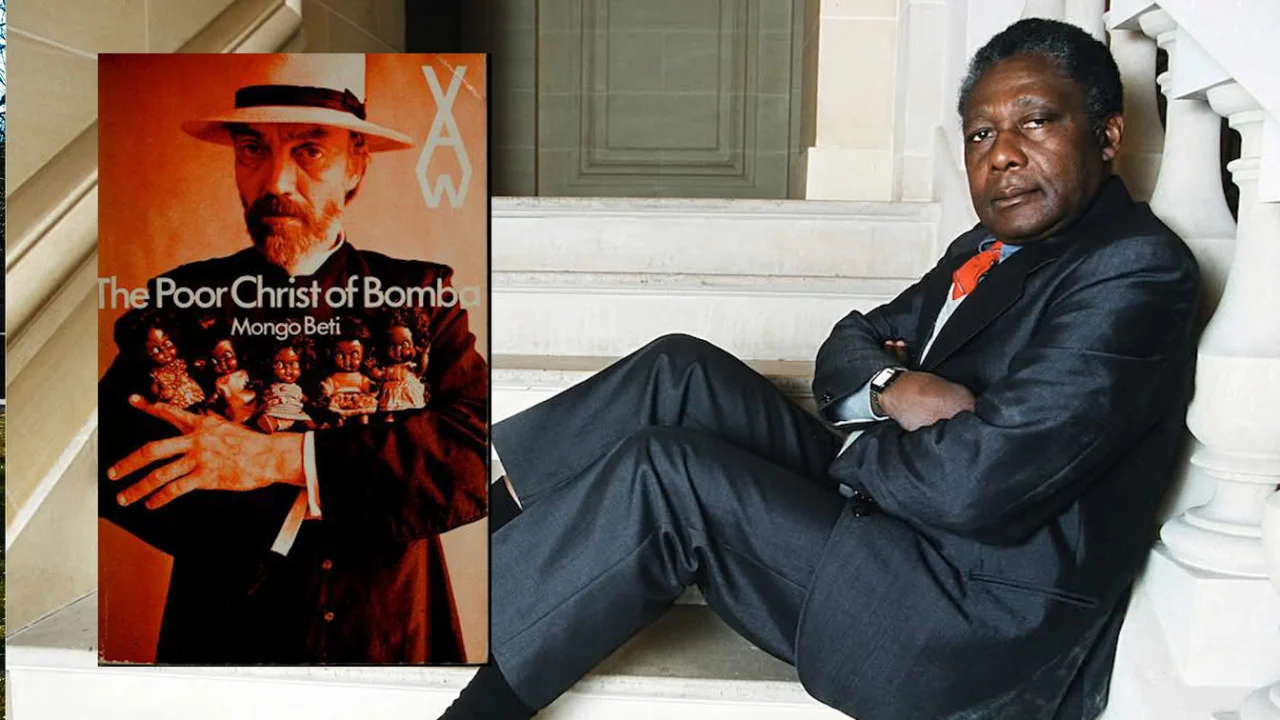
Imagine dedicating twenty years of your life to saving souls, only to discover that the people you wanted to enlighten cared more about cocoa money, sewing machines, gramophones, and new wives than your sermons. Picture your closest allies in this sacred mission transforming your project into a village brothel. And after all that effort, you start wondering if perhaps the villagers were better off without you.
This is exactly the world that Mongo Beti unveils in his 1956 classic, The Poor Christ of Bomba. Known for his fearless critique of colonialism and missionary exploitation, Beti doesn’t pull any punches. Through the innocent eyes of a fifteen-year-old boy named Denis, he exposes the hypocrisy, greed, and contradictions of European missionaries in Cameroon.
👉 Grab your copy here: The Poor Christ of Bomba on Amazon
A Glimpse into the Story
The novel centers on Father Superior Drumont, a zealous European missionary who spends twenty years attempting to “save” the people of Cameroon. He builds a church and a training institution called the Sixa, where young women are prepared for Christian marriage. On paper, it sounds noble—but in reality, it’s a labor camp, and later, a site of corruption and sexual exploitation.
The story unfolds through the diary of Denis, whose naive and curious perspective captures the absurdities of Drumont’s mission. Denis observes, records, and occasionally misinterprets the events around him, giving the narrative a blend of humor, irony, and heartbreak.
Drumont’s grand strategy—abandoning the villagers for two years so they’d spiritually thirst for him—backfires spectacularly. Villages flourish without him, cocoa sales boom, and people pursue their own happiness, often in ways that contradict the missionary’s strict moral codes. The novel draws a stark contrast between areas under colonial oppression and those beyond the reach of roads and authorities, showing that faith imposed under duress is superficial, while independent communities thrive in freedom.
Themes and Analysis
Hypocrisy and Exploitation
Beti’s critique of colonial missionaries is ruthless. Father Drumont demands payment for confessions, sacraments, and church dues, punishes the innocent, and manipulates the vulnerable—all in the name of God. His cook, Zacharia, bluntly tells him:
“They say that all any of you are after is money. You are not sincere with them, you hide things from them and teach them nothing.”
The Sixa symbolizes the collapse of moral authority: intended as a site of Christian training, it becomes a brothel under unscrupulous catechists, revealing the dangers of unchecked institutional power.
Roads, Oppression, and Religion
The symbolism of roads in the novel is striking. Colonial roads, celebrated as progress, are actually instruments of oppression and forced labor. For Drumont, hardship is a divine tool: the more the people suffer, the more they’ll supposedly return to God. Beti connects infrastructure, colonial exploitation, and religion in a critique that resonates even today.
Innocence and Irony through Denis
Denis’s diary is both hilarious and insightful. His misunderstandings, like mistaking whispers for diarrhea, and his naïve sense of superiority over adults, highlight the contradictions and absurdities of colonial missions. Through Denis, Beti delivers biting social commentary without heavy-handed narration.
Transformation of Drumont
Perhaps the most compelling arc is Drumont himself. By the end, he questions the very mission that defined his life, realizing that Africans might worship and live meaningfully without European intervention. Beti gives us a rare portrait of a colonizer capable of self-reflection, making the novel more than just a critique—it’s also a story of possible redemption, albeit limited.
Why This Book Matters
The Poor Christ of Bomba is not just a historical novel; it’s a mirror held up to the contradictions of power, religion, and culture. It challenges readers to confront uncomfortable truths about missionary zeal, exploitation, and the legacy of colonialism. Beti’s work remains relevant for anyone interested in African literature, postcolonial studies, or moral philosophy.
Who Should Read This Book
You’ll enjoy The Poor Christ of Bomba if:
-
You’re drawn to African literature that confronts colonial histories.
-
You appreciate satire, irony, and moral critique in fiction.
-
You want complex characters and societal reflection rather than fast-paced plots.
You might struggle with this book if:
-
You prefer straightforward, heroic narratives.
-
You need a purely optimistic or uplifting story.
-
Explicit discussion of sexual exploitation and power abuse is uncomfortable for you.
👉 Pick up your edition here: The Poor Christ of Bomba on Amazon
About Mongo Beti
Born Alexandre Biyidi-Awala in 1932, Mongo Beti was one of Cameroon’s most influential novelists and essayists. He wrote under pseudonyms like Eza Boto and fiercely critiqued colonial and postcolonial corruption. His nonfiction work, Main basse sur le Cameroun (Rape of Cameroon), was so controversial it was banned in France and Cameroon. Beti’s novels, including Mission to Kala, remain essential reads for understanding the intersections of literature, history, and social critique. He passed away in 2001, leaving a legacy of fearless storytelling.
Final Thoughts
The Poor Christ of Bomba is a challenging but essential read. It strips bare the hypocrisies of colonial religion, the complexities of human desire, and the unintended consequences of missionary zeal. Through humor, irony, and deep social insight, Mongo Beti invites us to question authority, faith, and the very notion of “civilizing missions.”
If you’re ready to dive into a novel that blends historical critique with unforgettable storytelling, this is one to add to your shelf.
👉 Get your copy here: The Poor Christ of Bomba on Amazon