 English
 French
 German
 Russian
 中文
中文

The Diplomat Who Said Everything… and Somehow Avoided the Truth
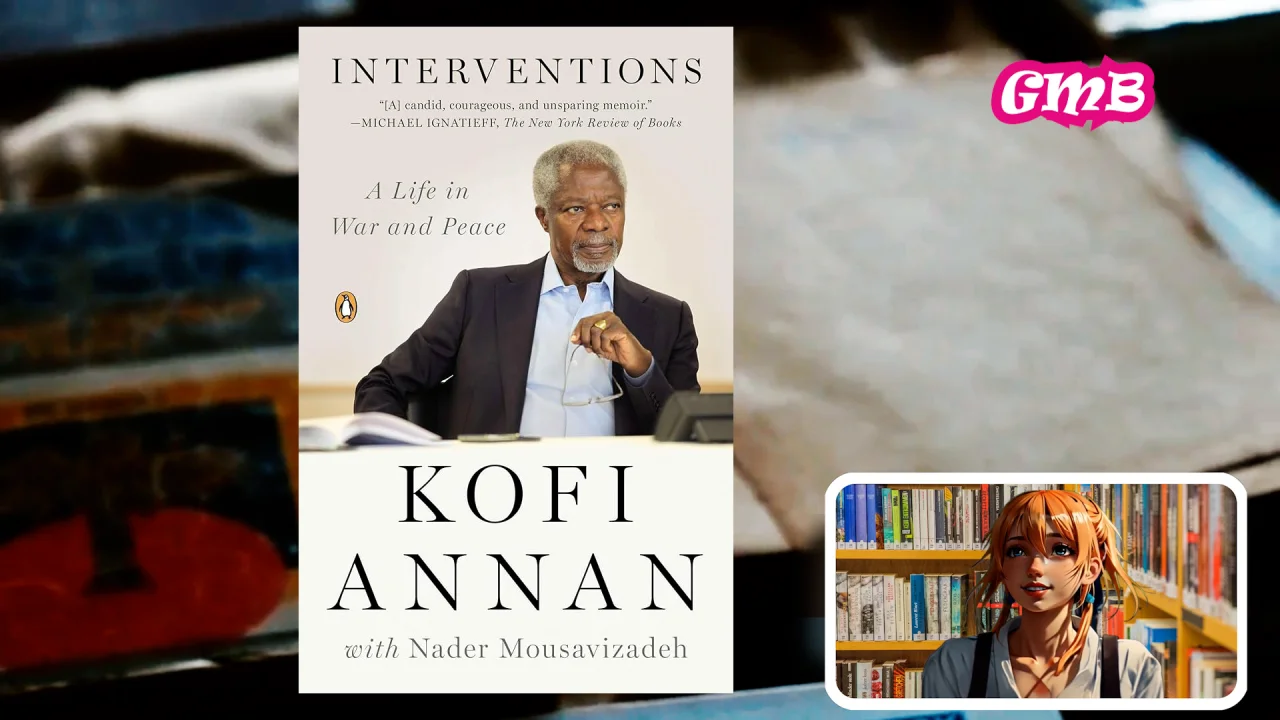
There’s a moment, early on, where I caught myself nodding along—thinking, this is it… this is where the curtain finally lifts.
A former UN Secretary-General, reflecting on war, peace, power, and failure? You expect honesty. Not perfection, not heroism—but clarity.
And then, slowly, something unsettling creeps in.
Not what is said… but what isn’t.
By the time I finished Interventions: A Life in War and Peace by Kofi Annan, I wasn’t frustrated because it was a bad book. I was frustrated because it felt like a carefully managed truth—polished, diplomatic… and incomplete.
What Kind of Book Is This?
This is a political memoir about power, responsibility, and the global idea of “intervention.”
Tone: Controlled, reflective, diplomatic
Pace: Moderate
Themes: Global power, intervention, diplomacy, inequality, accountability
This book is for readers who:
-
Want to understand how global institutions like the UN think
-
Enjoy political memoirs and behind-the-scenes diplomacy
This book is NOT for readers who:
-
Want brutally honest, no-filter confessions
-
Prefer sharp critiques over carefully balanced narratives
👉 The edition I read is available here:
https://amzn.to/4oCY2Uo
Summary (No Spoilers)
In Interventions, Annan walks us through his years at the United Nations—especially his time as Secretary-General during some of the world’s most volatile crises.
From Iraq to Rwanda, from Kosovo to Darfur, the book explores how the UN attempted to respond to conflicts that tested the limits of diplomacy and international law.
At its core, the book wrestles with one question:
When is it right to intervene—and who gets to decide?
But instead of offering a clear answer, Annan gives us something more complex… and sometimes more evasive.
Analysis & Review
What Works
There’s no denying it—this book gives you access.
You see how decisions are framed, how language is negotiated, how global leaders maneuver behind closed doors. Annan excels at showing diplomacy as a craft: careful, deliberate, often constrained.
His reflections on intervention are particularly compelling. You understand the tightrope he walked—between moral responsibility and political reality.
And to his credit, he does acknowledge tensions with powerful countries, especially the United States. There are moments where he subtly pushes back, where you can sense an effort to maintain independence within a system that clearly isn’t balanced.
That alone makes the book worth reading.
What Doesn’t Work
But here’s where things start to unravel.
The deeper you go, the more you notice a pattern:
critical issues are softened… redirected… or quietly avoided.
When discussing Africa, Annan often emphasizes poor leadership—and he’s not wrong. But the silence around Western interference is hard to ignore.
Figures like Patrice Lumumba or Kwame Nkrumah—leaders whose downfalls were tied to external forces—barely register in the narrative. The result is a story that feels incomplete, as if history happened in isolation.
Even more striking is how certain global systems are presented.
Take the International Criminal Court. Annan frames it as a triumph of justice. But the uncomfortable reality—that powerful nations often remain untouched—sits quietly in the background.
Or agriculture: he advocates for an African Green Revolution, yet only briefly acknowledges how Western subsidies undermine African farmers. It’s mentioned… then moved past.
And then there’s the subtle shaping of narratives.
Conflicts are described differently depending on where they happen. Protesters in one region are “hooligans.” In another, they are “democratic voices.” The inconsistency isn’t explained—it’s just… there.
At times, it feels less like a memoir and more like a document that has been carefully edited to maintain balance—even when imbalance is the real story.
The Personal Frustration
The most revealing part of this book isn’t what Annan says.
It’s what he chooses not to fully confront.
Because you can feel that he knows.
You can sense it in the way certain topics are approached—briefly, cautiously, almost as if naming them too clearly would disrupt the diplomatic tone he has spent a lifetime maintaining.
And maybe that’s the point.
This is a man who built a career on negotiation, on neutrality, on keeping conversations open. But that same instinct makes the book feel restrained—like it’s always holding something back.
Why This Book Matters
This book matters because it shows you how power explains itself.
Not in raw, unfiltered truth—but in language that is careful, reasonable, and… acceptable.
It forces you to ask uncomfortable questions:
-
Can global institutions ever truly be neutral?
-
Who defines “justice” on the world stage?
-
And how much truth gets sacrificed in the name of diplomacy?
What stayed with me wasn’t a specific event or decision.
It was the realization that the official version of history is often the most incomplete one.
And sometimes, the real story lives in the silence between paragraphs.
Who This Book Is Perfect For
You’ll enjoy this if:
-
You like books that make you question global systems
-
You enjoy political memoirs with layered meaning
-
You read nonfiction to think, not just to learn facts
You might struggle with this if:
-
You want direct, confrontational honesty
-
You prefer fast-paced, emotionally driven narratives
-
You need clear moral conclusions
👉 If this sounds like your kind of book, you can get it here:
https://www.amazon.com/dp/014104876X
My Honest Verdict
This isn’t a perfect book—but it’s a revealing one.
What works:
-
Insight into high-level diplomacy
-
A calm, thoughtful tone
-
Access to major global decisions
What doesn’t:
-
Selective storytelling
-
Lack of deeper accountability
-
A tendency to soften uncomfortable truths
And yet… I still recommend it.
Not because it tells you everything—but because it doesn’t.
Final Thoughts & Recommendation
If you go into Interventions expecting a full, unfiltered account of global politics, you might walk away disappointed.
But if you read it with a critical mind—paying attention not just to what’s written, but what’s missing—it becomes something far more interesting.
It becomes a study in how power presents itself.
And in that sense, this book stayed with me longer than I expected. Not because it answered questions—but because it quietly refused to.
👉 If you’d like to read the same edition I did, here’s the link:
https://amzn.to/4oCY2Uo