 English
 French
 German
 Russian
 中文
中文
Brave New World Review: Pleasure, Control, and the Cost of Happiness
A Chilling Welcome to the Future
Imagine a world where babies are grown in test tubes, nobody has a mother—or a father—and the worst thing you could say is… “Oh Ford!” Not “Oh God,” mind you. Ford is God here. Henry Ford. And in this society, his assembly line principles dictate not just industry—but life itself.
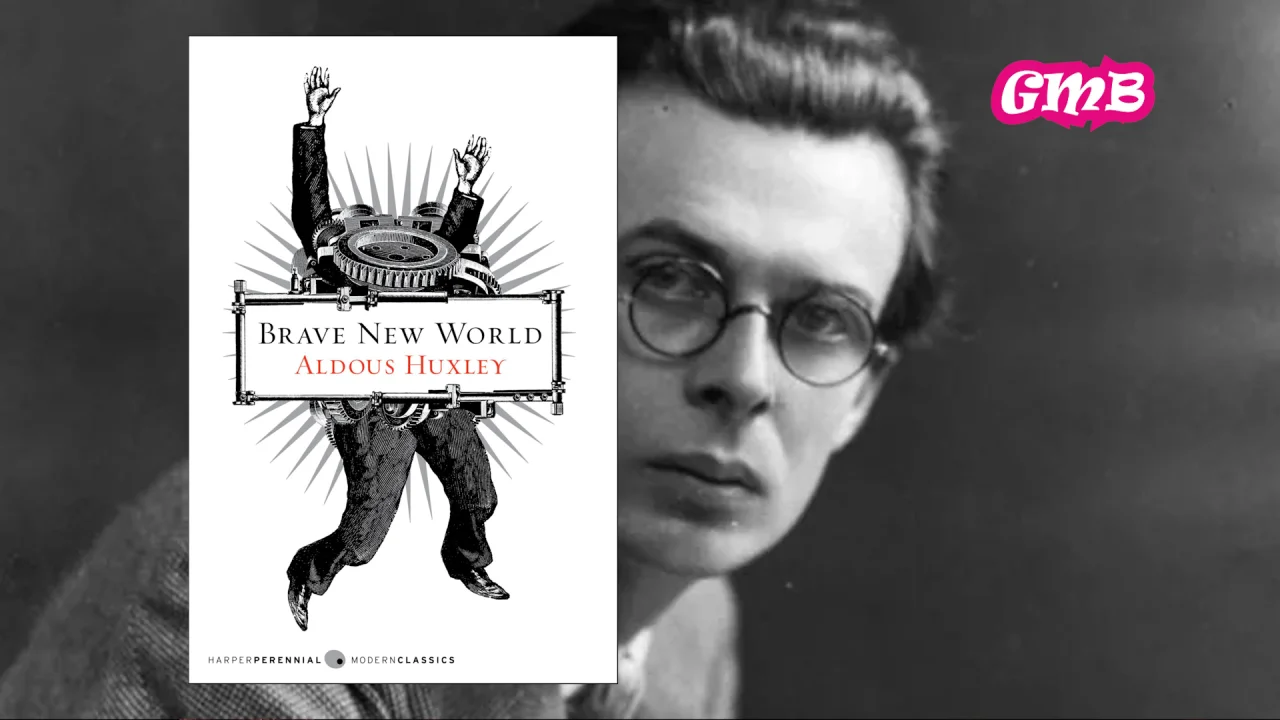
This is the unsettling world Aldous Huxley invites us into in Brave New World, first published in 1932. It’s a future without war, without poverty, and without suffering—but also without love, individuality, or true freedom. Reading it today feels eerily relevant, as the book’s satire and prophetic warnings echo in our era of consumerism, social media dopamine loops, and “happiness at all costs” culture.
👉 You can find the edition I read here on Amazon
The World State: Happiness, Engineered
Set in A.F. 632 (“After Ford,” or 2540 by our calendar), the World State is a civilization built on three pillars: Community, Identity, Stability. These aren’t just slogans—they’re biologically and psychologically enforced. Natural birth is obsolete. Humans are manufactured in the Hatchery using the Bokanovsky Process, a cloning method that produces dozens of identical humans at once. Each person’s role in society is predetermined, and conditioning ensures they’re happy with it.
From Alphas to Epsilons, everyone is content with their social destiny—but only because their minds are carefully trained from infancy. Hypnopaedia, or sleep-teaching, fills their heads with slogans like:
“Ending is better than mending.”
“Old clothes are beastly.”
“More stitches, less riches.”
Consumption becomes a civic duty, religion is extinct, sex is casual, and happiness is mandatory.
Sex, Soma, and Surreal Leisure
In the World State, attachment is taboo. Monogamy is perverted. Relationships exist only as fleeting pleasures. If sadness strikes? Don’t worry—there’s soma, the all-purpose, society-sanctioned drug that gives instant euphoria without consequences. It’s like a mix of Prozac, Xanax, weed, and LSD in a single sweet.
Even recreation is engineered to maintain control. Centrifugal Bumble-Puppy and Obstacle Golf aren’t just fun—they’re exercises in consumerism and distraction. In Huxley’s dystopia, pleasure itself is the pacifier of the masses.
The Misfits: Bernard Marx and John the Savage
Enter Bernard Marx, an Alpha Plus with the height of a Gamma, a brain for leadership, but a body that makes him feel inferior. He doesn’t fit in. He longs for privacy, emotional connection, and something more than programmed happiness.
Alongside Bernard is Lenina, a Beta conditioned for conformity, who can’t understand Bernard’s desire for exclusivity. Their journey to the Savage Reservation introduces them to Linda, a former World State citizen, and her son John—“the Savage”—born the old-fashioned way. Half-Indian, half-World State, John is caught between two worlds, none of which feel like home.
When Bernard brings John back to the city, John becomes a sensation. He quotes Shakespeare, refuses casual sex, and rejects soma. The citizens are fascinated, scandalized, and entertained. Bernard gains temporary social prestige, but John’s rebellion is ultimately unsustainable. In Huxley’s society, free thought is a threat to stability. Bernard and his friend Helmholtz Watson are exiled, while the World Controller Mustapha Mond explains the chilling logic: happiness requires sacrifice—not just of freedom, but of truth, depth, and meaning.
Why Brave New World Still Matters
Unlike 1984 or The Handmaid’s Tale, Huxley’s horror is subtle and seductive. It’s not pain that controls—it’s pleasure. People don’t rebel because there’s nothing to fight against. They’re too content, too conditioned, too distracted.
The book challenges us to ask:
-
What is the cost of happiness?
-
Can love, family, and creativity survive in a world engineered for comfort?
-
Are we truly making choices, or simply echoing the conditioning of our society?
“Actual happiness always looks pretty squalid in comparison with the overcompensations for misery.” – Aldous Huxley
Huxley’s dystopia is both satire and prophecy—a warning that the path to a pain-free utopia may strip away the very essence of humanity.
About Aldous Huxley
Aldous Huxley (1894–1963) was a British writer and philosopher, grandson of Thomas Huxley, “Darwin’s Bulldog.” Huxley combined his scientific curiosity with sharp social observation. Brave New World draws on mass production, Freud’s psychology, Pavlovian conditioning, and early consumer culture to imagine a terrifyingly plausible future.
He later revisited the themes in Brave New World Revisited, noting that the world was accelerating toward his dystopia faster than he’d feared. Look around today, and elements like algorithmic control, social media dopamine loops, and corporate happiness programs make Huxley’s vision feel uncomfortably near.
👉 Learn more about Huxley’s world here on Amazon.
Who Should Read This Book
You’ll enjoy Brave New World if you like:
-
Thought-provoking dystopias
-
Dark satire mixed with philosophical reflection
-
Stories that examine power, control, and the human psyche
You might struggle with it if you prefer:
-
Fast-paced plots and constant action
-
Clear heroes and villains
-
Definitive, happy endings
My Verdict
Brave New World isn’t a light read—but it’s unforgettable. Huxley’s mix of satire, horror, and prophecy offers a chilling reflection on the pursuit of comfort at the expense of freedom. While the pacing may feel slow at times, and some sections dense with world-building, the book’s insights are timeless.
This is a book that sticks with you long after the last page. It makes you question the systems around you, the “happiness” you accept, and even your own choices.
For anyone exploring dystopian classics—or the darker possibilities of human progress—this remains essential reading.
👉 You can pick up the edition I recommend here.
Final Thoughts
Removing pain, sorrow, and choice may seem like utopia—but Huxley forces us to see the cage hidden beneath the smile. Brave New World is a masterclass in subtle horror: the fear not of oppression, but of pleasure as control.
Which is worse, he asks—a boot stamping on a human face, or a warm soma pill melting it away?
If you’ve read Brave New World, join the conversation. Reflect on your own world. And maybe…question your happiness just a little more.